



















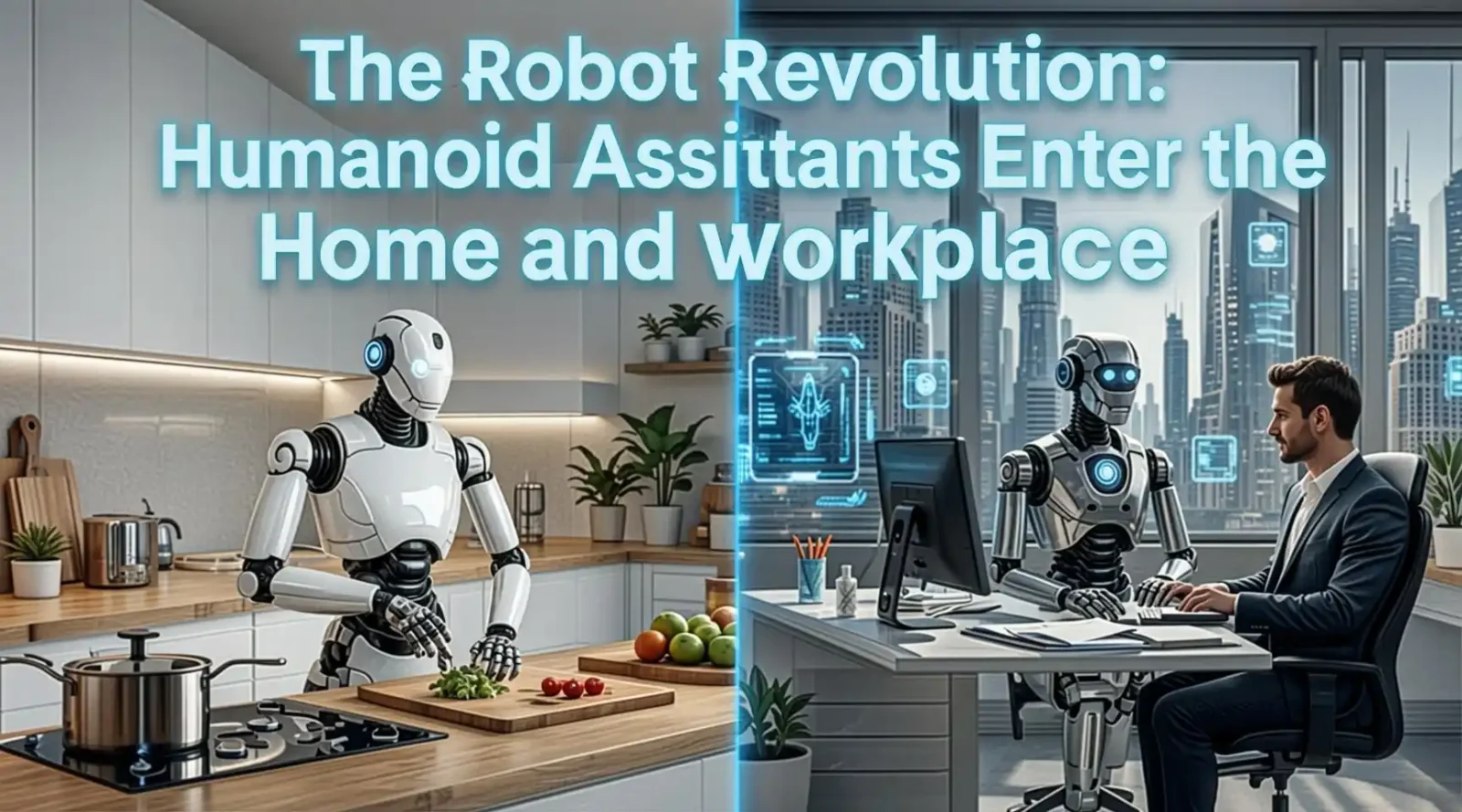
The Robot Revolution: Humanoid Assistants Enter the Home and Workplace
By [KRISHNAN] – Professional Tech Blogger
Published: April 11 2026
Introduction: From Science‑Fiction to Living‑Room Reality
Ten years ago, the idea of a robot that could pour you a cup of coffee, help your kids with homework, and attend virtual meetings beside you sounded like the plot of a blockbuster movie. Today, that scenario is no longer a distant dream. Thanks to rapid advances in artificial intelligence, sensor technology, and materials science, humanoid assistants are stepping out of prototype labs and into our kitchens, offices, and classrooms.
This post explores the forces driving the robot revolution, the real‑world use cases already proving their worth, the challenges we still face, and what the next five years could look like for humans and their mechanical companions.
- Why Humanoid? The Appeal of a Human‑Shaped Helper
| Feature | Traditional Automation | Humanoid Assistants |
| Physical interaction | Limited to repetitive tasks (e.g., assembly lines) | Can handle diverse, unstructured environments |
| Social presence | None (machines operate invisibly) | Facial expressions, gestures, and voice make interaction intuitive |
| Adaptability | Fixed tooling, programmed routines | Learning algorithms enable on‑the‑fly adaptation |
Humanoid form factors aren’t just about aesthetics. A torso, two arms, and a head allow a robot to leverage existing human‑centric infrastructure—standard door handles, kitchen cabinets, office chairs—without costly retrofitting. Moreover, a face that can smile or nod dramatically reduces the “uncanny valley” effect, making people more comfortable sharing space with a machine.
- The Home Front: Everyday Life with a Robotic Companion
2.1 Morning Routines Made Seamless
- Breakfast Prep: Robots like MiraChef can fetch ingredients, heat a pan, and flip pancakes with millimeter‑precise control.
- Personalized Wellness: Integrated health sensors monitor heart rate and posture, offering stretch reminders or hydration alerts.
2.2 Childcare and Education
- Homework Helper: Leveraging large‑language models, humanoids can explain algebra concepts while maintaining eye contact, which boosts student engagement.
- Safety Monitor: Real‑time object recognition alerts parents if a child is reaching for a hazardous item.
2.3 Elderly Care
- Companionship: Conversational AI provides social interaction, reducing loneliness—a leading factor in senior health decline.
- Medication Management: The robot dispenses pills according to a personalized schedule, and can call emergency services if a dose is missed.
Case Study: In Osaka, Japan, a trial deployment of the Kizuna humanoid in a senior‑living community reduced medication errors by 42 % and increased resident satisfaction scores from 3.2 to 4.7 out of 5 within six months.
- Workplace Integration: From Desk‑Side Assistants to Collaborative Co‑Workers
3.1 Administrative Efficiency
- Meeting Coordination: Robots can schedule, transcribe, and summarize meetings, flagging action items in real time.
- Document Handling: Physical filing and retrieval become automated; a robot can fetch a printed report from the archive and deliver it to a manager’s desk.
3.2 Manufacturing and Logistics
- Dynamic Assembly: Unlike fixed robotic arms, humanoids can switch tasks on the fly—assembling a circuit board one hour, then assisting with quality‑control inspection the next.
- Warehouse Picking: Using advanced vision, they navigate aisles, lift boxes up to 15 kg, and place items onto pallets with minimal human supervision.
3.3 Creative Collaboration
- Design Brainstorming: With multimodal interfaces—voice, gesture, and even sketch‑recognition—humanoids can act as “thinking partners,” generating design alternatives and instantly visualizing them in AR.
Industry Insight: A 2025 Deloitte survey of 1,200 global enterprises reported that 57 % plan to pilot humanoid assistants in customer‑service hubs within the next 12 months, citing “enhanced brand perception” and “24/7 availability” as top drivers.
- Technical Foundations: What Makes Modern Humanoids Tick
- Large‑Scale Language Models (LLMs): Enable natural, context‑aware conversation, translating human intent into actionable commands.
- Edge‑Optimized Compute: Specialized AI chips (e.g., NVIDIA Orin, Google Edge TPU) allow real‑time perception without reliance on cloud latency.
- Soft‑Actuated Mechanics: Variable‑stiffness joints mimic human muscle tone, improving safety when operating near people.
- Multimodal Sensor Fusion: Combining LiDAR, depth cameras, tactile arrays, and microphones yields a 360° situational awareness akin to human senses.
- Challenges & Ethical Considerations
| Challenge | Current Mitigation | Open Questions |
| Safety & Liability | Built‑in force limits, ISO/TS 15066 compliance | Who is legally responsible in an accident? |
| Data Privacy | On‑device processing, encrypted communication | How to balance personalization with data minimization? |
| Job Displacement | Re‑skilling programs, “human‑robot teaming” models | What social safety nets are needed? |
| Bias in AI | Diverse training datasets, continuous auditing | How to ensure cultural sensitivity across global deployments? |
Addressing these issues isn’t optional; it’s a prerequisite for public trust. Companies that champion transparent governance and inclusive design will lead the market.
- Looking Ahead: The Next 5‑Year Horizon
- Affordability: Unit cost projected to drop 30 % by 2029 as mass‑production techniques (e.g., 3‑D printed exoskeletons) mature.
- Regulatory Frameworks: Expect standardized certification pathways similar to automotive safety (Euro NCAP for robots is already in pilot).
- Human‑Centric Design Evolution: Expect more “emotionally intelligent” robots capable of detecting subtle facial cues and adjusting tone accordingly.
- Hybrid Workspaces: Offices will feature “Robot Pods”—designated zones where humanoids manage logistics, freeing humans for strategic work.
Imagine a typical weekday in 2030: your kitchen robot has already prepared a nutrient‑balanced lunch, your office assistant has updated the project board, and a warehouse humanoid has safely loaded your order for same‑day delivery—all while you focus on creative problem‑solving. The robot revolution isn’t about replacing us—it’s about amplifying what we can do.
Conclusion
Humanoid assistants are poised to become as commonplace as smartphones once were. Their ability to blend physical dexterity with conversational intelligence opens doors to a future where home and work environments are safer, more efficient, and more human‑centric. As with any transformative technology, the journey will involve technical breakthroughs, policy decisions, and societal adaptation. By staying informed and engaging in the conversation, we can ensure that this robotic partnership enriches our lives rather than eclipses them.
Keywords
- Humanoid robots
- AI assistants
- Future of work
Hashtags
#RobotRevolution #HumanoidAssistants #FutureOfWork
Disclaimer
The information presented in this article is for general informational purposes only and reflects the author’s viewpoints based on publicly available data as of April 2026. It does not constitute professional advice, endorsement of specific products, or a guarantee of future performance. Readers should conduct their own research and consult qualified experts before making decisions related to the purchase, deployment, or use of humanoid robotic assistants.












Leave a comment