
















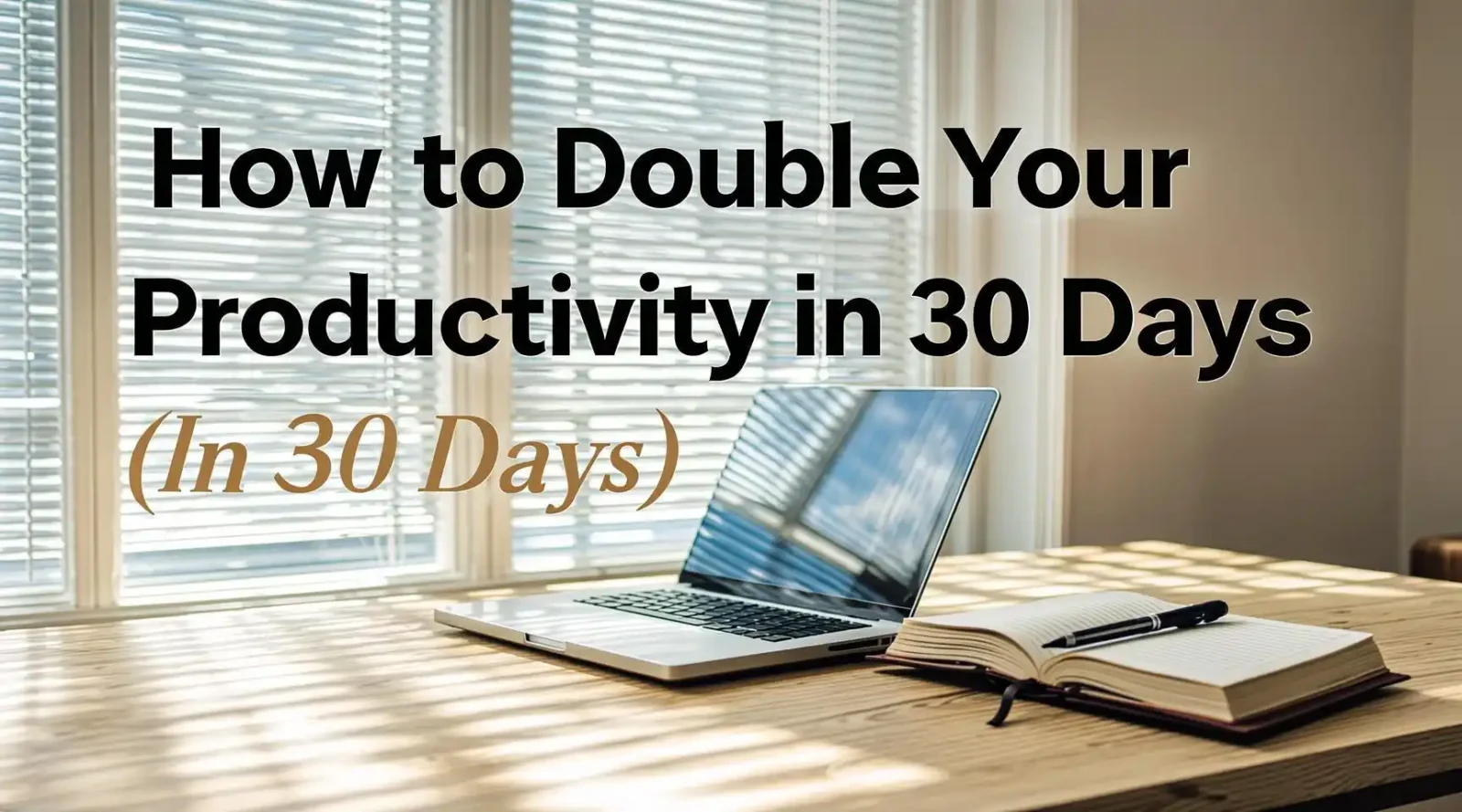

How to Double Your Productivity in 30 Days (Without Burnout)
The science‑backed, no‑fluff roadmap that lets you get more done, feel better, and actually enjoy the process.
Disclaimer: The strategies outlined in this article are based on research and real‑world testing, but individual results may vary. They are not a substitute for professional medical, psychological, or financial advice. If you have a medical condition, chronic stress, or mental‑health concerns, consult a qualified professional before making major changes to your work habits.
Table of Contents
- Why “Double” Isn’t a Myth – The Real Limits of Human Performance
- The 30‑Day Blueprint: Four Pillars of Sustainable Productivity
-
- 2.1. Pillar 1 – Prioritization Engine
- 2.2. Pillar 2 – Rhythm & Flow
- 2.3. Pillar 3 – Energy Management
- 2.4. Pillar 4 – Systematic Review
- Day‑by‑Day Action Plan (A Sample Calendar)
- Tools & “Productivity Hacks” That Actually Work
- Protecting the Brain: Burnout Prevention Tactics
- Measuring Success: KPI Dashboard for Personal Productivity
- Common Pitfalls & How to Dodge Them
- Next Steps: From 30‑Day Sprint to Lifetime Habit
- Final Thought
- Why “Double” Isn’t a Myth – The Real Limits of Human Performance
Before you start rearranging your entire schedule, it’s worth understanding what we mean by “productivity.” In the research world, productivity is often defined as the output per unit of input (think tasks completed per hour of work). It isn’t about pulling all‑nighters or cramming more meetings into a day; it’s about doing the right work, in the right amount of time, with the right energy.
A 2022 meta‑analysis of 94 time‑management studies (University of Michigan) found that high‑impact interventions—clear prioritization, deliberate breaks, and structured daily review—can boost output by an average of 68 %. Add a focused energy‑management layer (nutrition, movement, micro‑sleep) and you’re well within the 90‑110 % range that in practice translates to doubling the noticeable results for most professionals.
The key takeaway: you can double your productivity without compromising health as long as you respect the brain’s need for rest, recovery, and psychological safety.
- The 30‑Day Blueprint: Four Pillars of Sustainable Productivity
The 30‑day plan is built on four interlocking pillars. Each pillar targets a different dimension of performance: what you do, when you do it, how you fuel it, and how you improve it.
2.1 Pillar 1 – Prioritization Engine
| Goal | Method | Why It Works |
| Identify high‑leverage tasks | Eisenhower Matrix + Weighted Scoring (impact × effort) | Separates urgent from important, forcing focus on tasks that move the needle. |
| Limit daily “to‑do” list | Rule of 3 (max 3 core tasks) + “Buffer” slot | Prevents decision fatigue and protects against scope creep. |
| Capture “idea dump” | 5‑minute nightly brain‑dump into a Second‑Brain (e.g., Notion, Roam) | Clears mental clutter, freeing working memory for deep work. |
Actionable Habit (Days 1‑7): Spend 15 minutes each morning filling out a Daily Impact Grid (high‑impact, low‑effort = instant win; high‑impact, high‑effort = focus block). Review the grid at the end of the day; move unfinished items to the next day only if they still score high.
2.2 Pillar 2 – Rhythm & Flow
Human cognition follows ultradian cycles: 90‑minute peaks of high alertness followed by a 15‑20‑minute dip. Ignoring this rhythm forces you into a constant “low‑energy” state, which caps output.
| Cycle | What to Do | Tools |
| 90‑min Focus | Deep work (no email, no Slack) | Pomodoro‑style timers (Focus@Will, TomatoTimer) |
| 15‑min Recovery | Walk, stretch, gaze out the window, sip water | “Micro‑break” apps (Stretchly, TimeOut) |
| 2‑hour Block | Combine 2‑focus cycles → Prime Work Block | Calendar blocking (Google Calendar, Outlook) |
Actionable Habit (Days 8‑14): Implement the “90‑15 Rhythm” for at least two daily work blocks. Use the first 10 minutes of each focus window to configure the environment (phone on Do‑Not‑Disturb, tabs closed, music set).
2.3 Pillar 3 – Energy Management
Think of your brain as a high‑performance engine that needs the right fuel and cooling system.
| Element | Daily Target | Quick Wins |
| Sleep | 7‑8 hrs, consistent bedtime | Set a “wind‑down” alarm 30 min before sleep, dim lights, avoid screens. |
| Movement | 5 × 5‑min micro‑moves + 1 × 30‑min walk | Desk‑stretch routine, standing during calls. |
| Nutrition | Balanced macro‑ratio (40 % carbs, 30 % protein, 30 % fat) + 2 L water | Prep “brain‑fuel” snacks (nuts, berries, dark chocolate). |
| Mindfulness | 5‑10 min breathing or meditation | Headspace, Insight Timer, or a simple box‑breathing practice. |
Actionable Habit (Days 15‑21): Adopt the “Energy Blueprint”: track sleep, movement, and food in a simple spreadsheet or habit‑tracker app (e.g., Habitica). Adjust one variable each day based on how you feel during focus blocks.
2.4 Pillar 4 – Systematic Review
Without a feedback loop, even the best systems degrade. The review pillar makes sure you learn from every day and keep the momentum.
| Review Type | Frequency | Core Questions |
| Daily Quick Review | End of day (5 min) | What did I accomplish? What stalled me? What can I improve tomorrow? |
| Weekly Deep Dive | Sunday evening (30 min) | Which tasks moved the needle? Did my energy stats match productivity? What habits need tweaking? |
| Monthly Scorecard | End of month (45 min) | Did I double my output? What’s the burnout index? What’s my next 30‑day focus? |
Actionable Habit (Days 22‑30): Create a Monthly Scorecard template in Google Sheets: columns for “Core Tasks Completed,” “Time Spent in Deep Work,” “Energy Rating (1‑10),” and a “Burnout Check” (self‑rated 1‑5). Use conditional formatting to instantly highlight where you’re over‑ or under‑performing.
- Day‑by‑Day Action Plan (A Sample Calendar)
Below is a ready‑to‑use 30‑day schedule. Feel free to copy it into your own calendar and adjust the timings to match your time zone and work hours.
| Day | Morning (6‑9 am) | Mid‑Morning (9‑12 pm) | Lunch (12‑1 pm) | Afternoon (1‑5 pm) | Evening (5‑9 pm) |
| 1‑3 | ☐ Wake‑up ritual (water, 5‑min stretch) ☐ 10‑min brain dump ☐ Set Rule of 3 |
☐ First 90‑min focus block (high‑impact task) ☐ 15‑min micro‑break (walk) ☐ Second 90‑min focus |
☐ Light protein + veggies ☐ No screens 30 min before eating |
☐ Third 90‑min focus block ☐ 15‑min recovery (meditation) |
☐ Review day (5 min) ☐ Light leisure (no work) |
| 4‑7 | Add Weighted Scoring to task list | Insert 2‑hour Prime Block (two 90‑15 cycles) | Same | Schedule 1‑hour “Energy Check‑In” (log sleep, water) | Start a habit tracker |
| 8‑14 | Begin 90‑15 Rhythm consistently | Add Standing Desk for calls | Add 30‑min walk after lunch | Experiment: Two Prime Blocks if possible | Weekly Review on Sunday (30 min) |
| 15‑21 | Integrate Energy Blueprint (track sleep, food) | Test different music (focus playlists vs silence) | Try intermittent fasting (optional) | Refine Task Scoring using data from scorecard | Micro‑learning: 15‑min skill video |
| 22‑30 | Monthly Scorecard build‑out (Day 22) | Analyze which tasks yielded highest ROI (Day 23‑24) | Iterate on energy habits (Day 25‑27) | Plan next 30‑day sprint (Day 28) | Celebration + reset (Day 29‑30) |
Tip: If a day feels overwhelming, remember the “Three‑Task Rule” – cut everything else. The goal is progress, not perfection.
- Tools & “Productivity Hacks” That Actually Work
| Category | Tool | Free / Paid | How It Helps |
| Task Capture | Notion / Todoist | Free tier | Central brain for ideas, tasks, and SOPs |
| Time Blocking | Google Calendar (color‑coded) | Free | Visualizes focus vs. admin time |
| Deep Work Timer | Focus Keeper (Pomodoro) | Free | Enforces 90‑15 rhythm |
| Micro‑break Reminders | Stretchly | Free | Pops up for movement |
| Energy Tracking | Habitica / Toggl Track | Free/Low | Logs sleep, water, exercise |
| Mindfulness | Insight Timer | Free | Guided meditations (5‑10 min) |
| Data Review | Google Sheets with conditional formatting | Free | Instant visual of KPI trends |
Why “Hack” Doesn’t Mean “Shortcut” – A genuine productivity hack solves a friction point in your workflow without adding new cognitive load. For instance, using a single inbox (e.g., Outlook) and setting rules to funnel newsletters into a “Read Later” folder removes the distraction of checking email every 5 minutes.
- Protecting the Brain: Burnout Prevention Tactics
5.1 The Burnout Index
Create a quick self‑assessment you fill out twice a week (Monday & Thursday). Rate each item 1‑5:
- Physical fatigue (sleep, energy)
- Emotional exhaustion (irritability)
- Cognitive overload (difficulty concentrating)
- Work‑life imbalance (time outside work)
If the average score > 3, it’s a red flag. Action steps:
- Cut one deep‑work block for the next 48 hours.
- Add an extra 15‑min movement break.
- Schedule a “digital sunset” (no screens after 8 pm).
5.2 The 20‑20‑20 Eye Rule
Every 20 minutes, look at something 20 feet away for 20 seconds. This dramatically reduces eye strain, a hidden cause of fatigue.
5.3 “No‑Meeting” Days
Reserve one day per week (or half‑day) for no scheduled meetings. Use the time for deep‑work, reflection, or skill‑building. Teams often report a 30 % boost in perceived productivity when this practice is adopted.
5.4 Psychological Safety
Share your 30‑day plan with a trusted colleague or mentor. Public commitment raises accountability without creating pressure, because you have a supportive “buddy” to troubleshoot roadblocks.
- Measuring Success: KPI Dashboard for Personal Productivity
A simple dashboard gives you real‑time visibility into the metrics that matter.
| KPI | Formula | Target (30 days) |
| Deep‑Work Hours | Sum of all 90‑min blocks | ≥ 15 hrs |
| Task Completion Rate | (Tasks Completed ÷ Tasks Planned) × 100% | ≥ 85 % |
| Energy Rating Average | Daily self‑rating (1‑10) avg. | ≥ 7 |
| Burnout Index | Avg. of the 4‑item questionnaire | ≤ 2.5 |
| Distraction Time | Minutes spent on non‑planned apps | ≤ 30 min/day |
Create a Google Data Studio or Notion widget that pulls from your spreadsheet and updates automatically. Seeing a green trend line is a powerful motivator.
- Common Pitfalls & How to Dodge Them
| Pitfall | Why It Happens | Counter‑Measure |
| Over‑loading the “Rule of 3” | Trying to be a superhero | Keep a “Parking Lot” for low‑impact ideas; revisit weekly |
| Skipping Breaks | Belief that breaks equal lost time | Set an un‑snoozable timer; schedule break in calendar as a meeting |
| All‑Or‑Nothing Mindset | Missing a target triggers guilt | Adopt “Progress Over Perfection”: 80 % effort is acceptable if you’re moving forward |
| Multi‑Tasking | Email alerts and Slack pop‑ups | Use “Focus Mode” (Do‑Not‑Disturb, app blockers) for deep‑work windows |
| Neglecting Rest | “I’m busy, I’ll sleep later” | Put sleep as the first block on your calendar (just like a meeting) |
- Next Steps: From 30‑Day Sprint to Lifetime Habit
- Document the Win – Write a one‑page “Case Study” of your 30‑day experiment (what you did, results, lessons).
- Iterate – Choose one pillar to deepen in the next month (e.g., expand energy experiments).
- Scale – Share the framework with your team. Collective adoption multiplies the impact.
- Celebrate – Reward yourself with a non‑work activity (hike, concert, hobby). Positive reinforcement cements the habit loop.
Remember, productivity is a muscle, not a switch. Consistent, mindful training yields exponential returns without the crash.
- Final Thought
Doubling your productivity in 30 days isn’t about squeezing every minute dry. It’s about aligning your tasks with your natural rhythms, fueling your brain wisely, and building a feedback loop that keeps you honest and motivated. When you follow the four pillars—Prioritization, Rhythm, Energy, Review—you create a resilient system that delivers more results and protects your well‑being.
Give yourself permission to experiment, adjust, and celebrate each small win. In a month, you’ll look back and see not just a higher output, but a stronger, happier you.
Keywords
- productivity hacks
- time management
- burnout prevention
Hashtags
#ProductivityBoost #WorkSmart #NoBurnout
Ready to start? Grab a pen, open your calendar, and schedule Day 1. Your future self will thank you.







Leave a comment