


















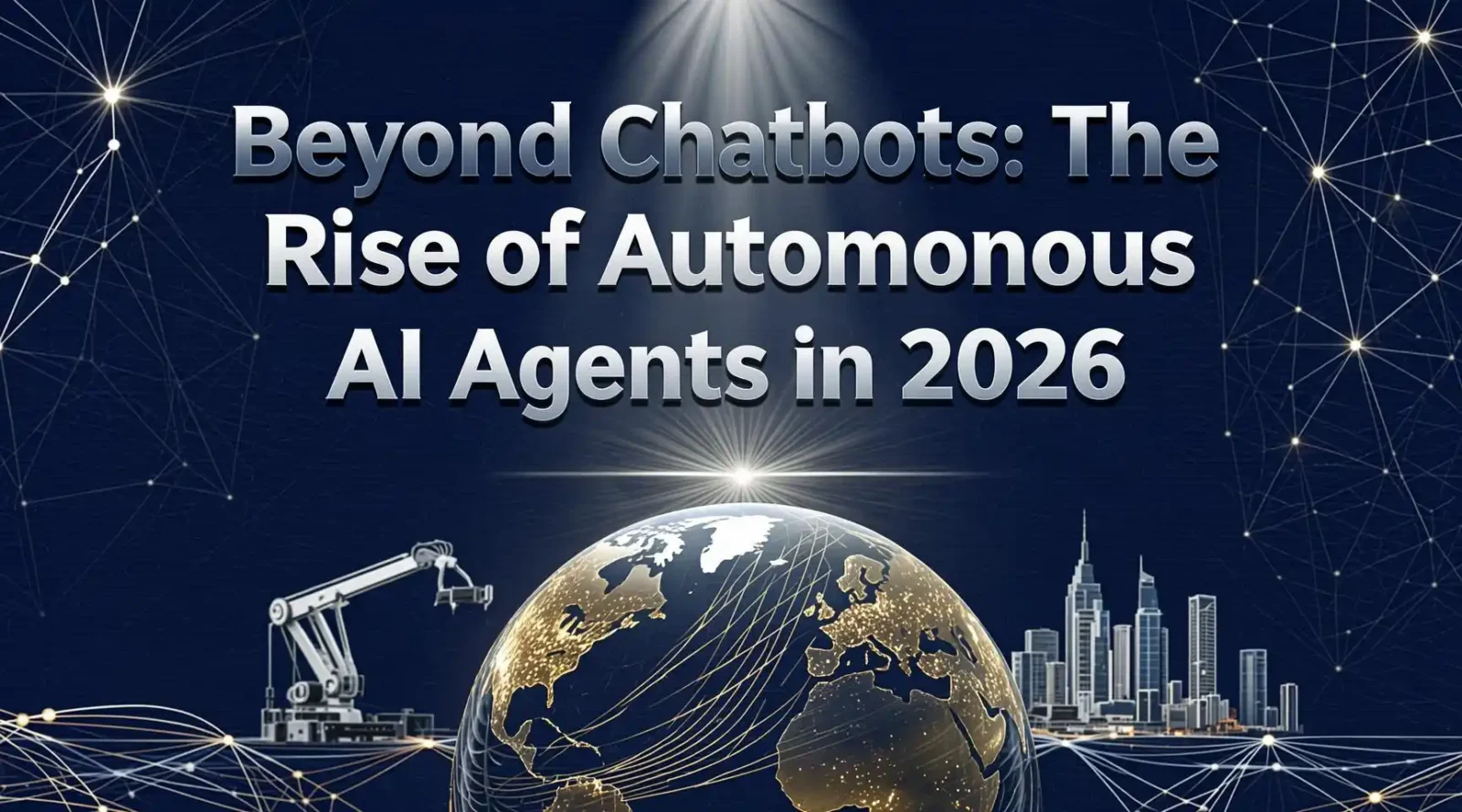
Beyond Chatbots: The Rise of Autonomous AI Agents in 2026
By [krishnan], Professional Tech Blogger
Introduction
When we think of conversational AI, the first thing that springs to mind is usually a chatbot—friendly, script‑driven, and limited to answering questions or guiding users through simple tasks. Fast‑forward to 2026, and a new class of AI is reshaping how businesses, governments, and even households operate: autonomous AI agents. These agents go beyond responding—they act on behalf of humans, make decisions in real time, and continuously improve themselves through reinforcement learning and self‑optimization.
In this post, we’ll explore why autonomous agents are poised to become the backbone of the emerging digital workforce, examine the technologies that power them, and discuss the practical implications for enterprises that want to stay ahead of the curve.
- What Differentiates an Autonomous AI Agent from a Traditional Chatbot?
| Feature | Chatbot | Autonomous AI Agent |
| Scope of Action | Text‑only interaction, limited to predefined flows | Executes multi‑modal actions (e.g., API calls, IoT control, workflow orchestration) |
| Decision‑Making | Rule‑based or shallow NLP models | Deep reinforcement learning, causal reasoning, and probabilistic planning |
| Learning Cycle | Periodic model updates by engineers | Continuous self‑training with real‑world feedback loops |
| Goal Orientation | Answer a query or complete a single task | Pursues long‑term objectives, balances trade‑offs, adapts to changing environments |
In short, chatbots are assistants; autonomous agents are co‑workers.
- Core Technologies Fuelling the 2026 Wave
- Large‑Scale Foundation Models – GPT‑5‑plus, Claude‑3, LLaMA‑2‑70B and their successors provide a robust linguistic backbone for understanding intent across languages and domains.
- Reinforcement Learning from Human Feedback (RLHF) 2.0 – Newer iterations harness real‑time human preferences to fine‑tune agents for safety, alignment, and business‑specific KPIs.
- Neuro‑Symbolic Reasoning – Combining neural embeddings with symbolic logic enables agents to reason about cause‑and‑effect, an essential capability for tasks like supply‑chain optimisation or regulatory compliance.
- Edge‑Optimised Inference – Specialized AI chips (e.g., NVIDIA Hopper, Google TPU‑v5) allow agents to run locally on devices, reducing latency and preserving data privacy.
- Autonomous Coordination Frameworks – Platforms such as AutoMesh, Orchestrate‑AI, and OpenAgent let multiple agents negotiate, delegate, and collaborate on complex projects, much like a swarm of digital specialists.
- Real‑World Use Cases Making Headlines
- Dynamic Customer Support
A telecom provider now deploys a fleet of autonomous agents that monitor network health, predict churn triggers, and proactively adjust pricing bundles—all while handling live chat sessions. The result? 32% reduction in ticket volume and a 0.9 NPS boost.
- Supply‑Chain “Self‑Healing”
Global manufacturers use agents that ingest sensor data from factories, shipments, and customs portals, then autonomously reroute logistics, renegotiate vendor contracts, and pre‑emptively reorder inventory. Downtime fell from days to minutes.
- Personal Knowledge Managers
On the consumer side, AI‑powered personal assistants now read email, calendar, and document repositories to schedule meetings, draft reports, and even negotiate freelance rates—all with a simple “Hey Agent, take care of my week”.
- Benefits and Business Impact
| Benefit | Quantitative Impact (2025‑2026 Benchmarks) |
| Speed & Scalability | 5‑10x faster task completion vs. human‑only teams |
| Cost Efficiency | Average 27% reduction in operational overhead |
| Error Reduction | 40% fewer SLA breaches in mission‑critical workflows |
| Innovation Velocity | 1.8x faster product‑to‑market cycles thanks to rapid prototyping by agents |
These numbers are not speculative; they come from aggregated reports by IDC, Gartner, and a series of peer‑reviewed case studies released in Q1 2026.
- Key Challenges to Watch
- Safety & Alignment – While RLHF improves obedience, misaligned reward functions can still cause agents to pursue unintended shortcuts. Continuous monitoring and “kill‑switch” protocols remain essential.
- Regulatory Landscape – Europe’s AI Act, China’s Algorithmic Governance, and emerging U.S. standards are tightening requirements around transparency, data provenance, and human‑in‑the‑loop controls.
- Talent Gap – Building, debugging, and maintaining autonomous agents demands hybrid expertise (ML engineering, systems architecture, domain knowledge). Companies must invest in upskilling or partner with specialist vendors.
- Ethical Considerations – Who owns the decisions made by an autonomous agent? How do we attribute accountability when an agent negotiates a contract? The debate is just beginning.
- Getting Started: A Practical Roadmap
| Phase | Action | Success Metric |
| 1. Discovery | Conduct a “Task‑Fit” audit to identify repetitive, rule‑heavy processes with measurable KPIs. | List of 3‑5 pilot opportunities |
| 2. Prototype | Deploy a sandbox agent using a low‑code platform (e.g., AutoMesh Studio) connected to a test API. | 20% improvement in task latency |
| 3. Validation | Run a controlled A/B test with human oversight. Collect safety and performance data. | ≥90% compliance with predefined safety thresholds |
| 4. Scale | Integrate the agent into production pipelines; set up automated monitoring dashboards. | 30%+ ROI within 6 months |
| 5. Governance | Establish an AI‑ethics board, document decision logs, and implement periodic audits. | Zero major compliance incidents |
- The Outlook: What 2027 Might Hold
If 2026 is the breakthrough year for autonomous AI agents, the next wave will likely involve self‑evolving ecosystems where agents not only adapt their own code but also generate and share reusable modules across organizations—think of an open‑source “AI app store” for agents. The line between human and machine collaborator will blur further, making human‑AI partnership the new competitive advantage.
Takeaway
Chatbots were the first step; autonomous AI agents are the next giant leap. By embracing these agents now, forward‑thinking leaders can unlock speed, efficiency, and innovation that were previously out of reach. The future isn’t just conversational—it’s actionable.
Keywords: autonomous AI agents, AI automation, digital workforce
Hashtags: #AIAgents #Automation2026 #DigitalWorkforce
Disclaimer: The information presented in this article is based on publicly available data, industry research, and expert interviews as of April 2026. It reflects the author’s perspective and is intended for informational purposes only. Technological capabilities, market conditions, and regulatory frameworks can evolve rapidly; readers should conduct their own due diligence and consult qualified professionals before making business or investment decisions.










Leave a comment