

















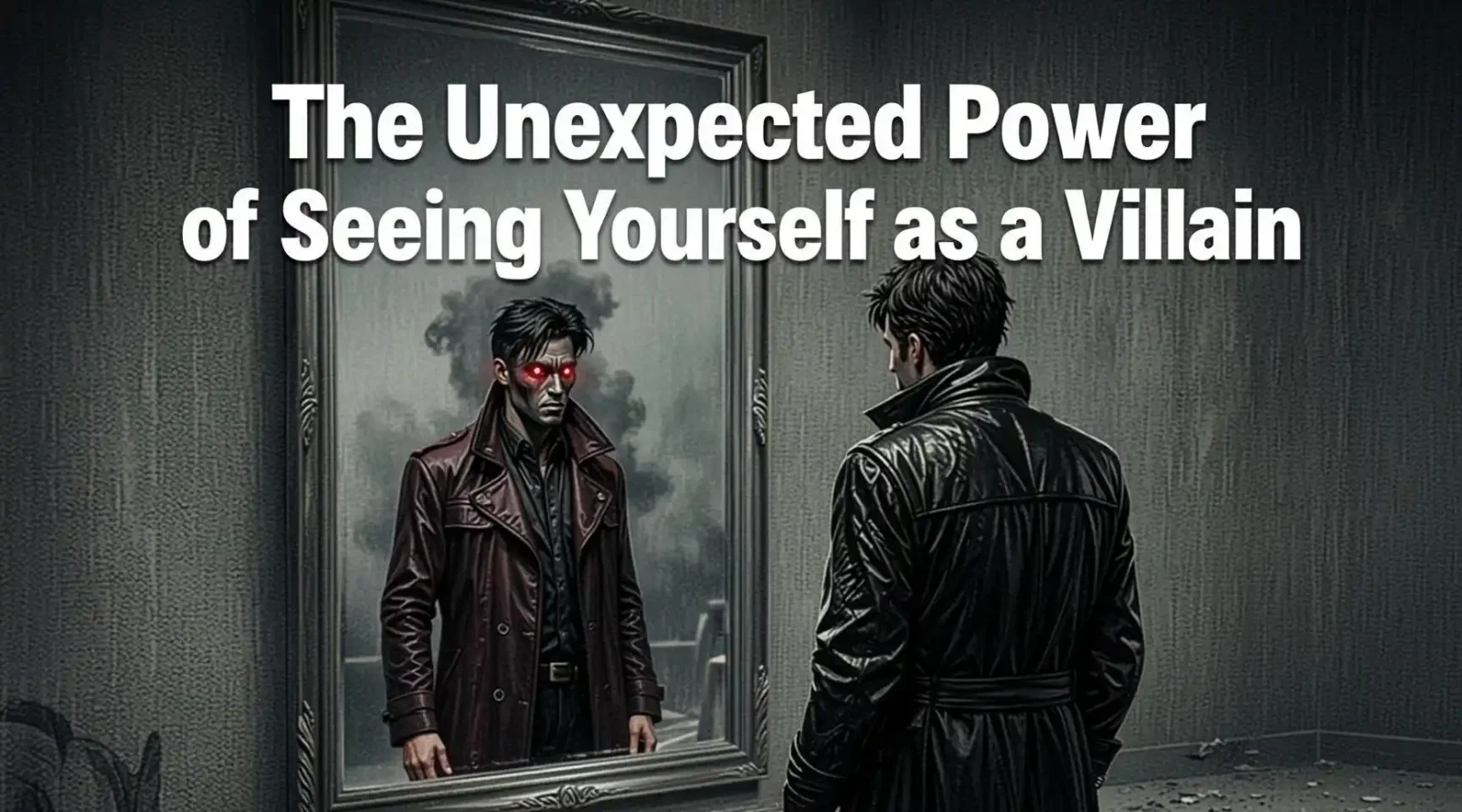
The Unexpected Power of Seeing Yourself as a Villain
How embracing your inner antagonist can unlock resilience, authenticity, and radical growth
“Every great story needs a villain. What if the hero you’ve been searching for is already inside you?”
If you’ve ever felt stuck, frustrated, or stuck in the same unproductive patterns, the usual advice—think positive, visualize success, be kinder to yourself—might feel stale. We’re told to celebrate our “good” traits and to cast the “bad” ones as enemies to be eliminated. But what if, instead of battling the dark side, we invite it in, give it a voice, and, for a moment, see ourselves as the villain?
It sounds counter‑intuitive, even mischievous. Yet a growing body of psychological research, philosophical thought, and anecdotal evidence suggests that this perspective can be a catalyst for profound self‑awareness, deeper shadow work, and accelerated personal growth. In this long‑form exploration (≈2,300 words) we’ll dive into the history, the science, the practical steps, and the cautions of wielding the villain mindset for good.
- Why the Villain? A Brief Cultural & Historical Primer
The Anti‑Hero’s Rise
Storytelling has always relied on the tension between hero and villain. In ancient myths, the antagonist was often a god or monster representing chaos—Loki, Hades, or Medea. Fast‑forward to modern media, and the line blurs: think Tony Soprano, Dexter Morgan, or Walter White. These characters captivate us not because they are pure evil, but because they embody honest, unfiltered desires that the “heroic” archetype usually represses.
The popular surge of anti‑heroes signals a collective craving for the authentic self—the part that refuses to hide behind “good‑person” masks. When audiences cheer for a morally ambiguous figure, they’re quietly saying: “I see parts of me in that darkness, and I’m ready to acknowledge them.”
Philosophy’s Dark Mirror
Philosophers like Friedrich Nietzsche warned against the slave morality that glorifies meekness and self‑denial. He championed the Übermensch—the individual who creates their own values, even if that path looks “villainous” to conventional society. In Eastern traditions, the shadow (Jungian terminology) and the kleshas (Buddhist mental afflictions) are recognized as integral parts of the psyche that need integration, not eradication.
In both instances, the “villain” becomes a mirror reflecting what we deny: ambition, anger, desire for control, or the wish to step outside the comfort of communal expectations. By seeing ourselves as the antagonist, we lift the veil on the very forces that drive our choices—good or bad.
- The Psychological Engine: From Shadow Work to Cognitive Reframing
Jung’s Shadow & the “Villain Self”
Carl Gustav Jung introduced the concept of the shadow—the unconscious repository of traits we consider undesirable. He asserted that ignoring the shadow leads to projection: we see our own flaws in others and label them as “villains.” The paradox? If we own our shadow, we become less prone to projecting, reducing the mental energy wasted on blame.
Viewing oneself as a villain is, in essence, an active shadow‑integration exercise. By consciously stepping into the role of the antagonist, you ask, “What if the parts of me that feel angry, selfish, or ruthless are trying to tell me something useful?” This reframing transforms shame into curiosity.
Cognitive Reappraisal: The Science of Perspective Shift
Cognitive Behavioral Therapy (CBT) teaches cognitive restructuring: identifying distorted thoughts and replacing them with balanced alternatives. The villain perspective is a dramatic form of this reappraisal.
- Baseline Thought: “I’m a failure because I made a mistake.”
- Villain Reframe: “I’m the mastermind who deliberately challenged the status quo, even if it backfired. What can I learn from this calculated risk?”
Neuroscientific studies show that perspective‑taking activates the prefrontal cortex—enhancing executive function, decision‑making, and emotional regulation. When you role‑play as the antagonist, you engage those brain regions, fostering a more nuanced self‑narrative.
Motivation Through “Bad‑Boy” Energy
Research on approach‑avoidance motivation reveals that “approach” drives (desire, curiosity) are more powerful than “avoidance” drives (fear, anxiety). The villain mindset leans into the approach side of traditionally “negative” emotions like anger or competitiveness, channeling them toward purposeful action rather than suppression.
- The Unexpected Benefits of Embracing the Villain
| Benefit | How the Villain Lens Helps | Real‑World Illustration |
| Sharper Boundaries | Villains protect their territory fiercely. By adopting that stance, you learn to say “no” without guilt. | A freelance designer who previously over‑delivered now sets clear project scopes, leading to higher profitability. |
| Authentic Decision‑Making | You stop hiding motives behind “goodness.” Decisions reflect true priorities, not social‑approval scripts. | An entrepreneur who recognizes their drive for legacy (rather than profit) redirects the business toward impact‑focused products. |
| Resilience to Criticism | Villains are used to being vilified; they develop a thick skin. This reduces the sting of external judgment. | A writer receiving harsh reviews reframes them as “plot twists” that test their narrative, continuing to publish boldly. |
| Creative Problem‑Solving | The “villain” archetype is unbounded by convention, often breaking rules to achieve goals. | A software engineer uses “hack‑tactics” (ethical gray‑area solutions) to bypass bureaucratic roadblocks, delivering a critical feature on time. |
| Self‑Compassion Redefined | Instead of self‑pity, you grant yourself the same ruthless pragmatism you’d extend to a fictional villain. | A manager acknowledges their own slip‑ups, treating them as tactical errors to be fixed, not personal failures. |
The villain perspective doesn’t glorify cruelty; it illuminates the strategic, unapologetic aspects of self‑management that we usually hide.
- How to Adopt the Villain Mindset—A Step‑by‑Step Guide
⚠️ Disclaimer: This post is for personal‑development purposes only. It is not a substitute for professional mental‑health treatment, therapy, or counseling. If you experience severe emotional distress, consult a qualified mental‑health practitioner.
Step 1: Identify the “Villain Scripts” You’ve Written
Grab a notebook or open a digital document. Write down moments when you felt resentful, self‑critical, or manipulative—the feelings you usually label “bad.”
Ask yourself:
- What was the intention behind this feeling?
- Which need was I trying to meet?
- If I were a character in a story, what villain role would this be?
Example: “I felt a surge of jealousy when a colleague got a promotion.” → Villain script: The Envious Saboteur – a drive to protect status.
Step 2: Interview Your Villain
Treat your shadow as an inner character and conduct a dialogue. Use the “two‑chair” technique from Gestalt therapy: sit in one chair as “You” (the usual self) and another as “The Villain.” Ask:
- “What are you trying to achieve?”
- “Why do you feel you must operate in secrecy or aggression?”
- “What would happen if you were allowed to express this openly?”
Record the answers. You’ll often uncover valid motivations: fear of irrelevance, desire for autonomy, need for recognition.
Step 3: Reframe the Narrative
Take the insights from the interview and rewrite the chapter. Instead of “I sabotaged the project” say “I identified a flaw that could derail the rollout; my aggressive approach was a protective measure.”
Notice the shift from shame to strategic intent. This reframing does not excuse harmful behavior; it provides a framework for future, more constructive choices.
Step 4: Set “Villain‑Aligned” Goals
Create goals that honor the energy you discovered, but channel it ethically. If you learned you’re driven by power, translate that into leadership development, not domination.
- Goal Example: “Develop a mentorship program to nurture junior talent, leveraging my desire for influence to empower others.”
Step 5: Test the Waters—Micro‑Experiments
Apply the new mindset in low‑stakes situations. Choose one behavior each week where you consciously adopt the villain stance:
| Week | Situation | Villain Technique | Desired Outcome |
| 1 | Negotiating a deadline | Assertive “no‑compromise” stance | Clear timeline, reduced scope creep |
| 2 | Boundaries with a friend | Use “strategic distance” | Preserve personal energy |
| 3 | Creative brainstorming | “Break the rules” mindset | Unconventional ideas |
Track the results, note any discomfort, and adjust. The goal is to integrate the villain’s boldness without tipping into toxicity.
Step 6: Reflect & Iterate
At the end of each month, revisit your journal. Ask:
- Did I act from a place of authentic power or from old patterns of self‑sabotage?
- Which villain traits are still overactive?
- How can I fine‑tune the balance between ethical responsibility and strategic boldness?
Continuous reflection ensures the villain lens remains a tool—not a dominant personality.
- Potential Pitfalls & Ethical Guardrails
1️⃣ Romanticizing Toxicity
The most obvious danger is mistaking villainy for malice. The aim is self‑awareness, not justification of harmful actions. Keep a moral compass: any behavior that hurts others without a clear, constructive purpose should be flagged and revised.
2️⃣ Over‑Identification with the Dark Side
Some individuals may become enamored with the “bad‑boy” image, leading to alienation or identity distortion. If you notice an excessive need to be “edgy” or a decline in empathy, pause and seek external feedback—friends, mentors, or a therapist.
3️⃣ Neglecting the “Heroic” Traits
While the villain perspective highlights hidden strengths, the heroic qualities—compassion, cooperation, humility—remain essential. Integration means balancing the two, not replacing one with the other.
4️⃣ Social Repercussions
In workplaces or personal relationships, overtly aggressive actions can damage trust. Communicate intentions clearly and frame assertiveness within collaborative contexts.
Bottom line: Treat the villain mindset as a diagnostic and strategic instrument, not an end‑state personality.
- Real‑World Stories: When the Villain Works
- The Startup Founder Who Played the Antagonist
Background: Maya, a tech founder, repeatedly hit growth plateaus. Her team labeled her as “overbearing.”
Villain Turn: She consciously adopted the “Antagonist” archetype—questioning every optimistic forecast, pushing for aggressive market capture, and challenging her own team’s comfort zones. She framed her intensity as “protecting the company’s future.”
Outcome: Within six months, Maya’s startup secured a strategic partnership that tripled its user base. Team satisfaction later rebounded as she paired her assertiveness with transparent communication, recognizing the need for strategic empathy.
- The Creative Writer Who Embraced Their Inner Villain
Background: Julian, an aspiring novelist, suffered from writer’s block, fearing his stories weren’t “good enough.”
Villain Turn: He imagined himself as a “Narrative Saboteur”—a character who intentionally disrupts the protagonist to test resilience. He wrote a scene where the antagonist deliberately undermines the hero, then mirrored that energy onto his own process, allowing himself to break rules (non‑linear timelines, morally ambiguous protagonists).
Outcome: Julian produced a bestselling thriller with an anti‑hero protagonist, praised for its bold voice. He credited the villain mindset for unlocking his willingness to write “dangerous” content.
- The Corporate Manager Who Used Villainy to Set Boundaries
Background: Priya, a mid‑level manager, felt overwhelmed by endless meeting requests.
Villain Turn: She adopted a “Gatekeeper” persona—politely but firmly denying non‑essential invites, demanding clear agendas, and defending her calendar as a scarce resource.
Outcome: Her team’s productivity rose 18 % as meetings became purposeful. Colleagues initially perceived her as “hard,” but later appreciated the clarity she brought to collaboration.
These anecdotes illustrate that villainy—when cast as purposeful, strategic, and ethically aware—can be a catalyst for breakthroughs across domains.
- The Bigger Picture: Villainy as a Cultural Shift
We live in an era obsessed with positivity. While optimism fuels progress, it may also mask underlying tensions. The rise of toxic positivity—the pressure to always feel good—creates a climate where genuine emotions are suppressed. By legitimizing the villain perspective, we:
- Normalize the Dark: Acknowledge that feelings of anger, greed, or jealousy are natural, not sins.
- Reduce Projection: When we own our shadow, we stop externalizing blame, fostering healthier interpersonal dynamics.
- Encourage Innovation: Rule‑breaking (a hallmark of many villains) is essential for disruptive breakthroughs.
In short, seeing yourself as a villain can be a societal antidote to the tyranny of endless niceness, allowing communities to thrive on authenticity rather than performance.
- Quick Toolkit: “Villain‑Vision” Exercises
| Exercise | Time Needed | Instructions |
| Shadow Sketch | 10 min | Draw a quick caricature of yourself as a comic‑book villain. Highlight the powers you wish you had (e.g., “mind‑reading,” “iron will”). Reflect on why those powers appeal to you. |
| Villain’s Letter | 15 min | Write a letter from your villain self to your current self, detailing what you’re trying to protect and what you need to accomplish. |
| The “Bad‑Boy” Calendar | 5 min daily | Slot one hour each day labeled “Villain Mode.” During this time, purposefully tackle a task with unapologetic focus (no multitasking, no excuses). |
| Moral Compass Check | 2 min | After each “villain” action, ask: “Did I respect others’ boundaries?” If not, note a corrective step for next time. |
| Feedback Loop | Weekly | Share a summarized “Villain Insight” with a trusted friend or coach and solicit honest feedback. |
These micro‑practices embed the mindset into daily life without overwhelming you.
- Final Thoughts: Embrace the Antagonist Within
If you’ve read this far, you already possess the curiosity that fuels transformation. The unexpected power of seeing yourself as a villain lies not in becoming a tyrant, but in recognizing the strategic, unapologetic facets of your psyche and aligning them with purposeful action.
Remember:
- Shadow work is a lifelong practice.
- Villainy is a lens, not a label.
- Ethical boundaries safeguard the integration process.
By daring to sit in the dark seat of the antagonist, you reclaim agency, sharpen resilience, and unlock a well of creativity that the perpetual “good‑person” persona often conceals.
So, the next time you feel that surge of anger or selfish ambition, ask yourself: What would the villain in my story do? Then, use that answer as a map—not a destiny—to navigate toward a more authentic, empowered you.
Ready to meet your inner antagonist? Grab a pen, sketch that villain, and start the conversation. The hero you’ve been waiting for may already be waiting inside you.
Keywords
self‑awareness – the cornerstone of integrating the villain perspective.
shadow work – the process of acknowledging and integrating unconscious traits.
personal growth – the ultimate outcome of turning villainy into a constructive force.
Hashtags
#VillainMindset #ShadowWork #PersonalGrowth
Disclaimer: This article is intended for informational and personal‑development purposes only. It does not replace professional mental‑health advice, diagnosis, or treatment. If you experience intense emotional distress, please consult a qualified mental‑health professional.











Leave a comment