
















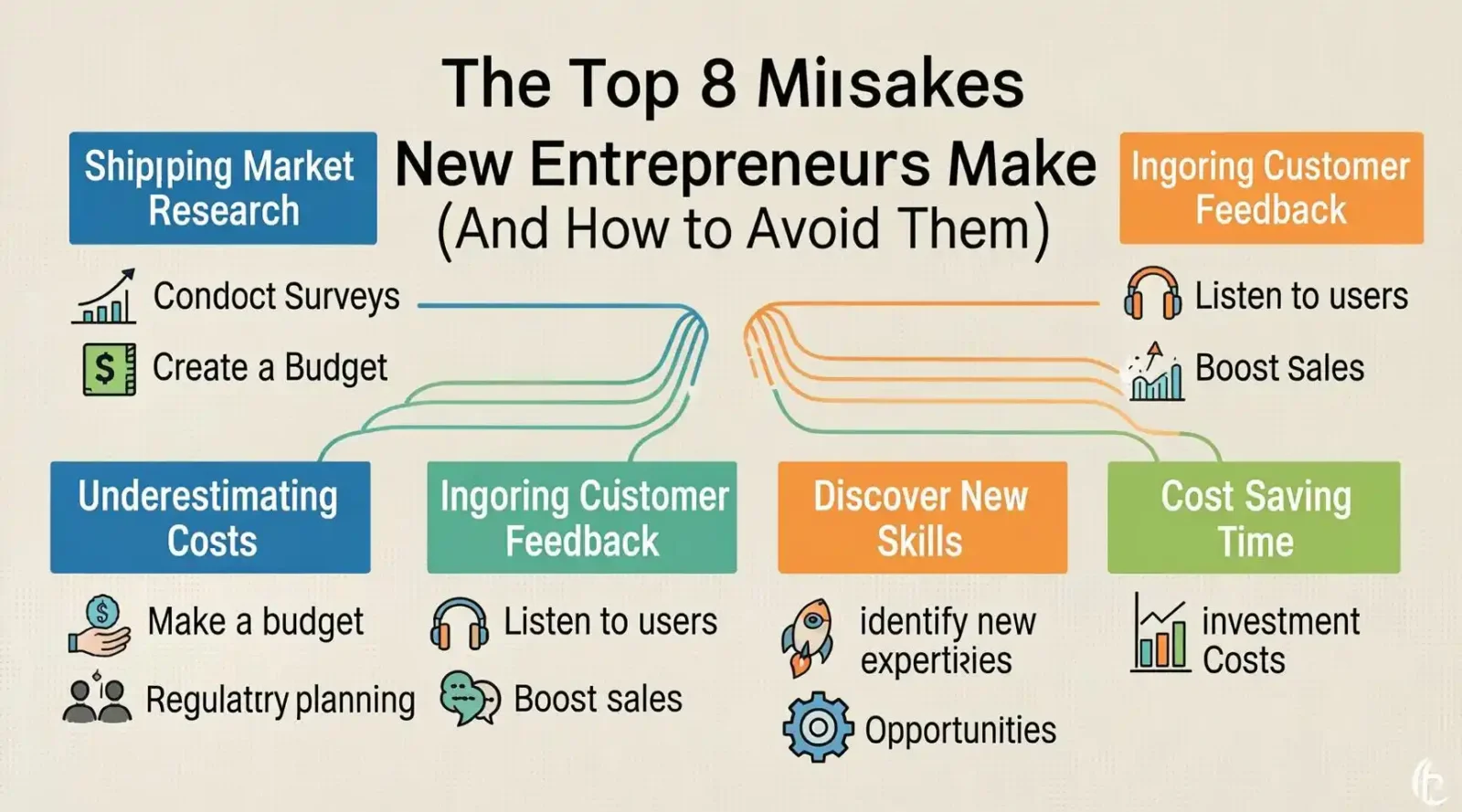
The Top 8 Mistakes New Entrepreneurs Make (And How to Avoid Them)
“The greatest mistake you can make in life is to be continually fearing you’ll make one.” – Elbert Hubbard
Starting a business is exhilarating. The freedom to turn a passion into profit, the thrill of solving real‑world problems, the chance to build something that outlives you—these are the dreams that keep budding founders up at night (and, occasionally, awake at dawn).
But the road from idea to sustainable venture is riddled with hidden pitfalls. New entrepreneurs, fresh off the hype cycle, often fall into the same avoidable traps. The good news? Most of these mistakes are preventable with the right mindset, solid planning, and a dash of seasoned advice.
In this deep‑dive, we’ll explore the eight most common errors made by first‑time founders, unpack why they’re costly, and give you a step‑by‑step playbook to sidestep each one. By the end, you’ll have a clear checklist to keep your startup on the fast lane to growth rather than the slow lane of regret.
📚 Table of Contents
- Skipping Market Validation
- Underestimating Cash Flow Management
- Building the Wrong Team
- Neglecting a Scalable Business Model
- Over‑Promising & Under‑Delivering
- Ignoring Legal & Compliance Basics
- Failing to Establish a Strong Brand Voice
- Letting Ego Drive Decision‑Making
Quick‑Reference Checklist – at the end of the post.
1️⃣ Mistake #1 – Skipping Market Validation
The Myth
“Great ideas sell themselves.”
That’s the romantic narrative sold in movies and startup podcasts. In reality, the market decides whether an idea will thrive.
Why It Costs You
- Wasted Resources – Hours, money, and energy spent developing a product that nobody wants.
- Opportunity Cost – Time that could have been spent on a real problem.
- Investor Red Flag – Venture capitalists look for data‑driven validation; skipping this step can shut doors before you even knock.
How to Avoid It
- Start with the “Problem‑Fit” Interview
- Talk to 30‑50 potential customers.
- Ask open‑ended questions: “What’s the biggest pain point you face when …?”
- Listen for recurring themes, not for compliments on your idea.
- Build a Minimum Viable Product (MVP)
- Strip the solution down to a single core feature that addresses the pain point.
- Use tools like Bubble, Webflow, or Prototyping kits to get it in users’ hands fast.
- Run a Pre‑Launch Test
- Deploy a landing page with a clear value proposition and a call‑to‑action (e.g., “Join the waitlist”).
- Run low‑budget ads (Facebook, LinkedIn, Reddit) to gauge click‑through and sign‑up rates.
- Measure, Iterate, Repeat
- Use North Star Metric (e.g., “Number of users who complete X action”) to track traction.
- Iterate based on data, not intuition.
Quick Action Box
| Step | Tool/Resource | Timeline |
| Customer interviews | Calendly + Zoom | 1‑2 weeks |
| MVP development | Bubble / Glide | 2‑4 weeks |
| Landing‑page test | Unbounce / Carrd | 1 week |
| First metric review | Google Analytics | Ongoing |
2️⃣ Mistake #2 – Underestimating Cash Flow Management
The Myth
“Revenue will magically appear once we launch.”
Cash flow is the lifeblood of any business; without it, even the best product with a loyal fanbase will drown.
Why It Costs You
- Run‑way Shrinkage – Running out of cash forces premature pivots or shutdown.
- Lost Credibility – Late payments to vendors or payroll erode trust.
- Growth Stagnation — Inability to invest in marketing or talent when opportunities arise.
How to Avoid It
- Create a 12‑Month Cash Flow Forecast
- List all expected inflows (sales, loans, investments) and outflows (rent, salaries, software subscriptions).
- Use a simple spreadsheet template or tools like Float or Pulse.
- Separate Personal & Business Finances
- Open a dedicated business checking account and a credit card.
- Allows clean bookkeeping and simplifies tax filing.
- Implement the “30‑Day Rule” for Expenses
- Any non‑essential expense >$200 must be approved after 30 days of review.
- Prevents impulse spending.
- Maintain a Minimum Cash Reserve
- Aim for at least 3‑6 months of operating expenses in a high‑yield savings account.
- Acts as a buffer for slower sales cycles or unexpected costs.
- Track KPIs Weekly
- Burn Rate (monthly cash outflow)
- Revenue Run‑Rate (projected annual revenue based on current month)
- Days Sales Outstanding (DSO)
Quick Action Box
| Item | Tool | Frequency |
| Cash‑flow forecast | Excel / Float | Monthly |
| Bank reconciliation | QuickBooks | Weekly |
| KPI dashboard | Looker Studio | Weekly |
3️⃣ Mistake #3 – Building the Wrong Team
The Myth
“You can do everything yourself at the start.”
While bootstrapping is common, the first hires set the DNA of your company.
Why It Costs You
- Cultural Misfit – Toxic early dynamics are hard to reverse later.
- Skill Gaps – Missing critical expertise delays product milestones.
- Turnover Expense – Hiring and re‑hiring burns cash and morale.
How to Avoid It
- Define Core Competencies Early
- List the top 3 skills that are absolutely non‑negotiable (e.g., product design, growth marketing, sales).
- Align hiring priorities to these.
- Hire for Culture Fit and Skill
- Use behavioral interview questions: “Tell me about a time you failed and how you recovered.”
- Rate candidates on both Technical Ability (1‑5) and Cultural Alignment (1‑5); aim for a combined score of 8+.
- Leverage Fractional Talent
- For functions like legal, finance, or CTO, consider consultants or part‑time partners before committing full‑time salaries.
- Create an Onboarding Playbook
- Include a “first‑week” roadmap, key documents (mission, values, SOPs), and a mentor buddy.
- Reduces ramp‑up time from weeks to days.
- Offer Equity Thoughtfully
- Use a standard 4‑year vesting schedule with a 1‑year cliff.
- Communicate the value of equity vs. cash to set realistic expectations.
Quick Action Box
| Phase | Action | Tool |
| Define roles | Skills matrix | Miro |
| Interview | Structured scorecard | Google Forms |
| Onboard | Playbook | Notion |
4️⃣ Mistake #4 – Neglecting a Scalable Business Model
The Myth
“If customers love the product, we’ll figure out the business later.”
Profitability isn’t an afterthought; it’s a design constraint from day one.
Why It Costs You
- Unsustainable Margins – High cost‑of‑goods sold (COGS) can cripple scaling.
- Pricing Confusion – Too low a price erodes perceived value; too high scares buyers away.
- Investor Hesitation – Lack of clear unit economics makes fundraising harder.
How to Avoid It
- Calculate Your Unit Economics
- Customer Acquisition Cost (CAC) – Total sales & marketing spend ÷ number of new customers.
- Lifetime Value (LTV) – Average revenue per user (ARPU) × gross margin × average customer lifespan.
- Rule of thumb: LTV ≥ 3 × CAC.
- Test Multiple Pricing Models
- Freemium – Offer a basic tier for free, charge for premium features.
- Subscription – Predictable recurring revenue (monthly/annual).
- Usage‑Based – Charge per transaction or per volume (e.g., SaaS compute usage).
- Conduct A/B pricing experiments using tools like ProfitWell.
- Identify Scalability Levers
- Automation – Replace manual processes with software.
- Outsourcing – Use third‑party logistics (3PL) to handle fulfillment at scale.
- API Integration – Open your platform to partners for network effects.
- Build a Financial Model for the First 3‑5 Years
- Project revenue, COGS, operating expenses, and cash flow.
- Stress‑test with scenarios: 20% slower growth, 15% higher churn, etc.
Quick Action Box
| Metric | Target (Early Stage) |
| CAC | ≤ $200 (depending on niche) |
| LTV | ≥ $600 |
| Gross Margin | ≥ 60% |
| Churn Rate | ≤ 5% monthly |
5️⃣ Mistake #5 – Over‑Promising & Under‑Delivering
The Myth
“Go big or go home—sell the vision, not the product.”
While a bold vision attracts early adopters, unrealistic promises sow distrust.
Why It Costs You
- Customer Attrition – Early churn fuels negative reviews and referrals.
- Brand Damage – Reputation recovery can take years.
- Legal Exposure – False claims may trigger consumer protection actions.
How to Avoid It
- Adopt a “Minimum Viable Pitch”
- Highlight only the features that are already built or within a definite roadmap (≤ 3 months).
- Set Transparent Roadmaps
- Publish a public product roadmap (e.g., on Trello or Productboard) and update it regularly.
- Mark items as “Committed”, “Planned”, or “Backlog”.
- Implement a “Beta First” Release Strategy
- Invite a small group of users to test upcoming features.
- Collect feedback, fix bugs, then open to the broader audience.
- Communicate Delays Proactively
- If a feature will miss the deadline, email affected users with a concise explanation and a revised timeline.
- Offer a compensation (e.g., extra credit, early‑access) where appropriate.
Quick Action Box
| Situation | Response |
| Feature not ready for launch | Release as “Beta” and gather feedback |
| Missed deadline | Send personal email, explain, and offer a small perk |
| Over‑zealous marketing claim | Review copy against product capabilities; get legal sign‑off |
6️⃣ Mistake #6 – Ignoring Legal & Compliance Basics
The Myth
“Legal fees are for big companies; we’ll figure it out later.”
Legal missteps can shut down a startup overnight—and cost more than a full‑time lawyer’s salary.
Why It Costs You
- Intellectual Property (IP) Loss – Failure to secure trademarks or patents invites copycats.
- Regulatory Penalties – GDPR, CCPA, HIPAA, and industry‑specific regulations carry hefty fines.
- Founder Disputes – No clear founder agreement leads to costly disagreements.
How to Avoid It
- Incorporate Early
- Choose a structure (LLC, C‑Corp, etc.) that aligns with your funding goals.
- Use services like LegalZoom, Clerky, or a local attorney.
- Draft Core Agreements
- Founders’ Agreement – Equity split, vesting, decision‑making process.
- Employee Offer & NDA – Protect trade secrets.
- Customer Terms of Service & Privacy Policy – Ensure compliance with data laws.
- Protect Your IP
- File a trademark for brand name/logo.
- If you have a novel invention, consider a provisional patent (U.S. 12‑month window).
- Keep meticulous innovation logs and use NDAs with contractors.
- Stay Informed on Industry Regulations
- Subscribe to newsletters from SBA, FTC, or relevant trade bodies.
- Conduct a compliance audit annually with a specialist.
Quick Action Box
| Legal Element | Timeline |
| Incorporation | Within 1 month of idea validation |
| Founders’ agreement | Before any equity issuance |
| Trademark filing | Within 2 months of brand finalization |
| Privacy policy posting | Before launch of live website |
7️⃣ Mistake #7 – Failing to Establish a Strong Brand Voice
The Myth
“Branding is just a logo; we’ll figure it out after we have customers.”
In a crowded market, a distinctive, authentic voice is a competitive moat.
Why It Costs You
- Low Recall – Customers forget you amid the noise.
- Inconsistent Messaging – Disjointed communication confuses prospects.
- Missed Loyalty – A relatable brand fosters community and repeat business.
How to Avoid It
- Define Your Brand DNA
- Mission – What problem you solve.
- Vision – Where the world looks after you succeed.
- Values – Core principles guiding decisions.
- Tone – Formal, friendly, witty, authoritative?
- Create a Brand Style Guide
- Logo usage, color palette, typography.
- Voice guidelines: sample sentences, dos & don’ts, emoji policy.
- Keep it in a shared workspace (e.g., Google Docs, Notion) for easy access.
- Consistent Content Across Channels
- Blog posts, social media, email newsletters, and customer support should all echo the same tone.
- Use a content calendar to plan and audit consistency.
- Leverage Storytelling
- Share origin stories, customer success, and behind‑the‑scenes moments.
- Humans remember narratives more than features.
Quick Action Box
| Asset | Key Question |
| Mission statement | “Why does our company exist?” |
| Tagline | “What single phrase captures our core benefit?” |
| Visual style | “Which colors evoke the emotions we want?” |
| Voice guide | “If our brand were a person, how would they speak?” |
8️⃣ Mistake #8 – Letting Ego Drive Decision‑Making
The Myth
“The founder knows best; we don’t need outside input.”
While confidence is essential, hubris blinds judgment.
Why It Costs You
- Missed Pivot Opportunities – Ignoring market signals leads to irrelevance.
- Team Disengagement – Employees feel unheard, reducing morale and productivity.
- Investor Distrust – VC’s look for founders who are coachable and data‑driven.
How to Avoid It
- Adopt a “Data‑First” Mentality
- Every major decision (pricing, hiring, roadmap) must have a metric backing it.
- Tools: Mixpanel, Amplitude, Google Analytics.
- Create an Advisory Board
- Recruit mentors, industry veterans, or seasoned entrepreneurs.
- Hold quarterly meetings to review performance and get candid feedback.
- Encourage Constructive Conflict
- Use frameworks like RACI (Responsible, Accountable, Consulted, Informed) to clarify who owns decisions.
- Host “post‑mortem” meetings after big launches to surface learnings.
- Practice Humble Leadership
- Publicly acknowledge mistakes and share corrective actions.
- Celebrate team wins, not just founder achievements.
Quick Action Box
| Practice | Frequency |
| Data review meeting | Weekly |
| Advisory board call | Quarterly |
| Post‑mortem debrief | After any major release |
| One‑on‑one with team leads | Bi‑weekly |
📈 Putting It All Together – A 30‑Day “Mistake‑Proof” Sprint
| Day | Focus | Deliverable |
| 1‑3 | Market Validation | 30 interview insights + MVP prototype |
| 4‑7 | Cash Flow Foundations | 12‑month cash‑flow forecast + bank account set‑up |
| 8‑10 | Team Blueprint | Skills matrix & first‑hire job description |
| 11‑13 | Business Model Canvas | LTV/CAC analysis + pricing experiment plan |
| 14‑16 | Product Roadmap | Public roadmap with “Committed” items |
| 17‑19 | Legal Essentials | Incorporation, founder agreement, NDAs |
| 20‑22 | Brand DNA | Mission, tagline, style guide draft |
| 23‑25 | Feedback Loop | Beta launch to 20 users, collect NPS |
| 26‑28 | Advisor Outreach | Secure 2‑3 advisors, schedule first call |
| 29‑30 | Reflection & Adjust | Sprint retrospective → update master plan |
Tip: Treat each 3‑day block as a sprint. Use Kanban boards (e.g., Trello) to visualize progress and keep momentum high.
✅ Quick‑Reference Checklist (All 8 Mistakes)
- Validated problem & demand with real user interviews.
- Cash‑flow forecast and minimum reserve in place.
- Core team defined, roles prioritized, and onboarding docs ready.
- Unit economics calculated; LTV > 3× CAC.
- Product promises match delivered features.
- Legal structure, founder agreement, IP protection secured.
- Brand voice and style guide documented.
- Feedback mechanisms and advisory board established.
🔮 Looking Ahead – Scaling Without Repeating Mistakes
Once you’ve cleared the early‑stage landmines, the next phase is growth acceleration. Here’s a high‑level roadmap for the next 12‑18 months:
- Data‑Driven Growth – Implement cohort analysis, funnel optimization, and paid‑acquisition scaling tests.
- Operational Automation – Migrate manual processes (e.g., invoicing, onboarding) to SaaS tools (Zapier, Gusto, HubSpot).
- Geographic & Segment Expansion – Use validated go‑to‑market frameworks (e.g., STP: Segmentation‑Targeting‑Positioning).
- Series‑A Funding Preparation – Build a compelling investor deck anchored by metrics from the checklist above.
- Culture Evolution – Institutionalize values through quarterly “culture days” and transparent OKR reviews.
Remember, mistakes are inevitable; it’s the frequency and impact that matter. By systematically addressing the eight common errors, you halt costly setbacks before they happen and build a resilient foundation for long‑term success.
📢 Final Thoughts
Starting a business is as much about mindset as it is about skill. The eight pitfalls listed above represent the most frequent “gotchas” that trip even the brightest, most passionate founders. The good news? All of them are fixable—and often preventable—with the right processes, data, and humility.
Take the checklist, run the 30‑day sprint, and revisit your progress weekly. Consider yourself not just a founder, but a chief mistake‑mitigator, shaping a company that learns faster than it loses.
“The only real mistake is the one you don’t learn from.” – Henry Ford
Now, go out there and build something that matters—wisely, sustainably, and with fewer regrets.
🔖 Keywords
- entrepreneurship
- startup mistakes
- business growth
📢 Hashtags
#Entrepreneurship #StartupTips #BusinessGrowth
⚠️ Disclaimer
The information in this article is for general educational purposes only and does not constitute legal, financial, or professional advice. Always consult with qualified professionals (e.g., lawyers, accountants, financial advisors) before making decisions that could affect your business or personal circumstances.








Leave a comment