


















How to Install RakuOS: A Step‑by‑Step Guide for 2026
Your comprehensive, up‑to‑date walkthrough from download to first‑boot configuration
Disclaimer: The procedures described in this article are based on the official RakuOS 2026 release as of April 2026. While every effort has been made to ensure accuracy, hardware variations, firmware quirks, or future software updates may affect the outcome. Always back up your important data before modifying partitions or installing a new operating system, and consult the official RakuOS documentation for the very latest information.
Table of Contents
- What Is RakuOS? – A Quick Overview
- Why Install RakuOS in 2026?
- Preparing for the Installation
- 3.1 System Requirements
- 3.2 Backing Up Existing Data
- 3.3 Creating a Live USB
- Booting Into the RakuOS Live Environment
- Installation Walkthrough
- 5.1 Launching the Installer
- 5.2 Language & Keyboard Layout
- 5.3 Disk Partitioning Options
- 5.4 User & Password Setup
- 5.5 Selecting Software Packages
- 5.6 Review & Begin Installation
- First‑Boot Configuration
- 6.1 Updating the System
- 6.2 Installing Additional Drivers
- 6.3 Enabling the Firewall & Security Tools
- Post‑Installation Tweaks & Recommended Apps
- Common Pitfalls & Troubleshooting
- Tips for a Smooth Experience on Dual‑Boot or UEFI Systems
- Wrapping Up – Where to Go From Here?
- What Is RakuOS? – A Quick Overview
RakuOS is an open‑source, community‑driven Linux distribution that blends a rolling‑release model with a curated set of up‑to‑date packages. Built on a modern kernel (currently 6.8 as of the 2026 release) and the Raku desktop environment, it emphasizes speed, minimalism, and a developer‑friendly toolbox.
Key selling points for 2026:
- Immutable base system with optional mutable layers (great for reproducible environments).
- ZFS‑ready out of the box, complete with snapshot management tools.
- Flatpak and AppImage support baked in, delivering the latest GUI applications without dependency hell.
- Integrated AI‑assisted package search via the newly introduced RakuAI index.
If you’re a developer, power user, or just someone who appreciates a sleek, responsive desktop, RakuOS has become a compelling alternative to mainstream distros.
- Why Install RakuOS in 2026?
| Feature | RakuOS 2026 | Competing Distros |
| Kernel version | 6.8 LTS (with back‑ported patches) | 6.5‑6.7 |
| Default file system | Btrfs (with ZFS option) | Ext4 |
| AI‑enhanced package manager (rakupkg) | ✅ | ❌ |
| Low‑latency audio stack | PipeWire + Low‑latency kernels | Variable |
| System installer | Graphical “Raku Installer” (modular) | Varies |
| Secure Boot support | Built‑in | Varies |
| Community support | 150 k+ active members (Discord, Matrix) | 300 k+ in larger distros, but more fragmented |
Bottom line: RakuOS delivers a future‑proof, secure, and developer‑centric environment that’s been polished for modern hardware (think of the latest AMD Ryzen 7000 series, Apple Silicon via virtualization, and ARM‑based laptops).
- Preparing for the Installation
3.1 System Requirements
| Minimum | Recommended |
| CPU: 64‑bit x86_64 or ARMv8 | CPU: 2+ cores, modern micro‑architecture |
| RAM: 2 GB | RAM: 8 GB+ |
| Storage: 12 GB free (Btrfs) | Storage: 30 GB+ (SSD/NVMe) |
| Graphics: Any with >800×600 resolution | GPU: Integrated or discrete with driver support |
| BIOS/UEFI with bootable USB support | UEFI with Secure Boot (optional) |
Tip: For a buttery‑smooth experience, a solid‑state drive (NVMe preferred) and at least 8 GB of RAM are strongly encouraged.
3.2 Backing Up Existing Data
If you’re installing over an existing OS or planning a dual‑boot, never skip a backup. Recommended options:
- Clone the drive with Clonezilla or dd for a full image.
- Sync important folders to an external HDD/SSD using rsync:
- rsync -avh –progress /home/youruser/ /media/backup_drive/youruser_backup/
- Create a cloud snapshot of critical files (Google Drive, Nextcloud, etc.) for added safety.
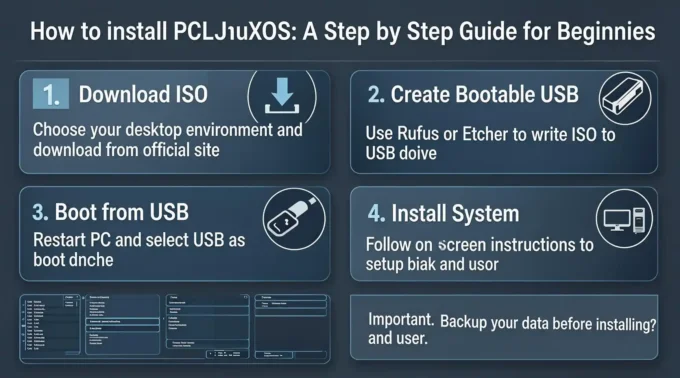
3.3 Creating a Live USB
- Download the ISO
- Head to the official site: https://downloads.rakuos.org/2026/rakuos-2026-amd64.iso.
- Verify the checksum (SHA256) to ensure integrity:
- sha256sum rakuos-2026-amd64.iso
- # Compare the output with the checksum on the download page.
- Choose a USB creation tool (depends on your current OS):
- Windows: Rufus (v4.4 or later).
- macOS: Balena Etcher or dd via Terminal.
- Linux: dd, gnome-disks, or Ventoy.
- Write the ISO (example with dd on Linux/macOS):
- sudo dd if=rakuos-2026-amd64.iso of=/dev/sdX bs=4M status=progress oflag=sync
Replace /dev/sdX with the correct device (e.g., /dev/sdb). Double‑check you have the right drive; a mistake will erase data.
- Eject safely and plug the USB into the target machine.
- Booting Into the RakuOS Live Environment
- Power on the computer and enter the firmware menu (usually F2, Delete, Esc, or F12).
- Navigate to the boot order and place the USB drive at the top.
- Save & exit; the system should restart into the RakuOS Live screen.
You’ll be greeted by a clean desktop with a “Try RakuOS” and “Install RakuOS” button. Select “Try RakuOS” first if you want to test hardware compatibility (Wi‑Fi, GPU drivers, Bluetooth, etc.) before committing.
- Installation Walkthrough
Once you’re ready, click “Install RakuOS” on the Live desktop. The installer is a polished, wizard‑style GUI – think “Ubuntu Ubiquity” meets “Fedora Anaconda”. Below is a step‑by‑step breakdown of each screen.
5.1 Launching the Installer
- Welcome Screen – Choose your language (affects UI, keyboard layout defaults, and help documentation).
- Click Continue.
5.2 Language & Keyboard Layout
- Language: Choose your preferred language (English (US) is default).
- Keyboard layout: Detect automatically or manually pick from a list.
- Press Next.
5.3 Disk Partitioning Options
RakuOS offers three “out‑of‑the‑box” partitioning schemes:
| Option | Description | When to Use |
| Erase disk and install RakuOS | Reformat the entire drive (Btrfs default). | Fresh install, no data to keep. |
| Install alongside existing OS | Shrinks existing partitions and creates a new Btrfs sub‑volume. | Dual‑boot scenarios. |
| Something else | Manual partitioning – perfect for LVM, encrypted LUKS, ZFS, or advanced layouts. | Power users, custom setups. |
Recommended “Something else” Configuration (Advanced)
- Boot mode: Confirm if your firmware is in UEFI or Legacy BIOS. For modern hardware, UEFI is preferred.
- Create a 300 MiB EFI System Partition (ESP)
- Type: EFI System Partition
- Filesystem: FAT32
- Mount point: /boot/efi
- Create a 2 GiB /boot partition (optional, but helpful for kernel rollbacks).
- Filesystem: Ext4 (or Btrfs if you love sub‑volumes).
- Mount point: /boot
- Create a root partition
- Size: ≥30 GiB (more if you plan to install many apps).
- Filesystem: Btrfs (or ZFS – choose “ZFS on Linux” kernel module).
- Mount point: /
- Create a swap partition (or swapfile later).
- Size: RAM size × 1‑2 (e.g., 8 GiB).
- Type: Linux swap.
If you want full‑disk encryption, select the “Encrypt the new partition” checkbox for each partition (or create a single encrypted LUKS container that houses the ESP and root). RakuOS will prompt you for a passphrase.
After partitioning, click Next.
5.4 User & Password Setup
- Full name: Your real name (optional).
- Username: Must be lowercase, no spaces.
- Password: Strong password (≥12 characters, mix of upper/lower, numbers, symbols).
- Log in automatically? (Not recommended for laptops in public spaces.)
- Require a password to unlock the screen? – Turn on for added security.
Press Next.
5.5 Selecting Software Packages
RakuOS ships with a modular installer that lets you pick a base environment:
| Base Profile | Description | Typical Use‑Case |
| Core | Minimal system (CLI + essential utilities). | Servers, containers, custom builds. |
| Desktop | Raku desktop + common apps (web browser, file manager, media player). | Everyday laptop/desktop usage. |
| Development | Adds compilers, IDEs, Docker, Rust, Go, Node.js toolchains. | Developers. |
| Multimedia | Audio/video codecs, GIMP, Blender, OBS. | Creators, streamers. |
Choose Desktop if you’re new, then tick additional groups you need (Development, Multimedia). The installer will compute download size and confirm.
5.6 Review & Begin Installation
A final summary appears: disk layout, user info, selected packages, network connectivity.
- Network: If you’re online, the installer will download the latest package list from RakuOS mirrors. You can also defer updates to post‑install.
Click Install.
Installation Time: Expect 5‑15 minutes on a modern SSD; slower on HDDs or when downloading many packages.
During this phase, the screen shows a progress bar, logs, and a friendly “Did you know?” tip rotating in the corner (e.g., “RakuOS includes built‑in AI suggestions for shell commands!”).
Once complete, the installer will prompt you to restart. Remove the USB when instructed.
- First‑Boot Configuration
6.1 Updating the System
Open a terminal (Ctrl + Alt + T) and run:
sudo rakupkg refresh # Refresh package index
sudo rakupkg upgrade # Upgrade all installed packages
Alternatively, use the Raku Software Center (GUI) → System → Updates.
6.2 Installing Additional Drivers
RakuOS detects most hardware automatically, but for proprietary GPU drivers:
- NVIDIA:
- sudo rakupkg install nvidia-dkms
- AMD (open-source, usually auto‑loaded).
- Wi‑Fi (e.g., Intel AX210):
- sudo rakupkg install iwlwifi-firmware
Reboot after installing drivers.
6.3 Enabling the Firewall & Security Tools
RakuOS ships with UTFT (User‑friendly firewall tool) and AppArmor profiles.
sudo systemctl enable –now utft.service
sudo systemctl enable –now apparmor.service
Open UTFT from the menu → toggle “Enable firewall”.
- Post‑Installation Tweaks & Recommended Apps
| Category | Recommended Packages (using rakupkg) | Why? |
| Shell enhancements | zsh, powerline-fonts, zsh-autosuggestions | Faster, more informative prompt. |
| Productivity | libreoffice-fresh, krita, obs-studio | Full‑featured office suite and creative tools. |
| Development | git, docker, vscode, neovim | Modern dev stack. |
| Gaming | steam, lutris, wine-staging | Play Windows games on Linux. |
| System utilities | htop, ncdu, bleachbit | Handy maintenance tools. |
| AI‑assistance | rakuai-cli | Voice‑activated command suggestions (experimental). |
Install them in one swoop:
sudo rakupkg install zsh powerline-fonts zsh-autosuggestions \
libreoffice-fresh krita obs-studio \
git docker vscode neovim \
steam lutris wine-staging \
htop ncdu bleachbit rakuai-cli
After installing Docker, add your user to the docker group:
sudo usermod -aG docker $USER
newgrp docker # reload groups without reboot
Setting Zsh as default shell
chsh -s /usr/bin/zsh
Log out/in to see the new prompt.
- Common Pitfalls & Troubleshooting
| Symptom | Likely Cause | Fix |
| “Boot failed – no bootable device” | ESP not flagged correctly or missing. | Re-enter BIOS → ensure UEFI mode is on. Reinstall, verify EFI System Partition is FAT32 and mounted at /boot/efi. |
| Wi‑Fi not detected | Missing firmware for newer chipsets. | sudo rakupkg install iwlwifi-firmware (for Intel) or sudo rakupkg install broadcom-wl (for Broadcom). |
| Screen flickering after login | NVIDIA proprietary driver mismatch. | Boot into recovery mode, purge nvidia-dkms, reinstall with correct kernel version (use sudo rakupkg reinstall linux-headers). |
| Random freezes with high CPU load | Swap file not active. | Create swap file: |
sudo fallocate -l 8G /swapfile
sudo chmod 600 /swapfile
sudo mkswap /swapfile
sudo swapon /swapfile
Add entry to /etc/fstab. | | sudo asking for password repeatedly | User not in wheel group. | sudo usermod -aG wheel $USER; log out/in. | | Unable to mount ZFS pool | Kernel module not loaded. | sudo modprobe zfs; enable zfs-import-cache.service. | | RakuAI CLI returns “model not found” | Offline mode or missing cache. | Run rakuai-cli –download-model while connected to the internet. |
For deeper logs, examine journalctl -b -p err or look at /var/log/installer.log (available after a failed install).
- Tips for a Smooth Experience on Dual‑Boot or UEFI Systems
- Turn off Fast Boot & Secure Boot (temporarily) – Some laptops lock the EFI variables, preventing the installer from writing to the ESP. You can re‑enable Secure Boot after installation; RakuOS provides signed Shim binaries.
- Create an EFI backup – Before overwriting the ESP, copy its content:
- sudo cp -r /boot/efi /boot/efi-backup
- Use the “Install alongside” option only if you’re sure the existing OS is using GPT. Mixing MBR & GPT on the same disk can break boot.
- If you are installing on a laptop with an eMMC, ensure you select the correct drive (/dev/mmcblkX).
- Set the bootloader priority via the firmware UI: place the “RakuOS” entry above Windows Boot Manager.
- Wrapping Up – Where to Go From Here?
You now have a fresh RakuOS 2026 installation, customized to your hardware and workflow. The next steps are entirely up to you:
- Explore the Raku Community – Join #rakuos on Discord or Matrix for tips, bug reports, and community projects.
- Contribute – If you feel adventurous, package a piece of software for the rakupkg repository or submit a pull request on the RakuOS GitHub.
- Automate with Ansible or Nix – Leverage RakuOS’s immutable base by creating reproducible configurations.
Enjoy the speed, stability, and developer‑centric perks of RakuOS. Happy hacking!
Keywords
- RakuOS installation
- Linux distribution 2026
- step‑by‑step guide
Hashtags
#RakuOS #Linux #OpenSource













Leave a comment