


















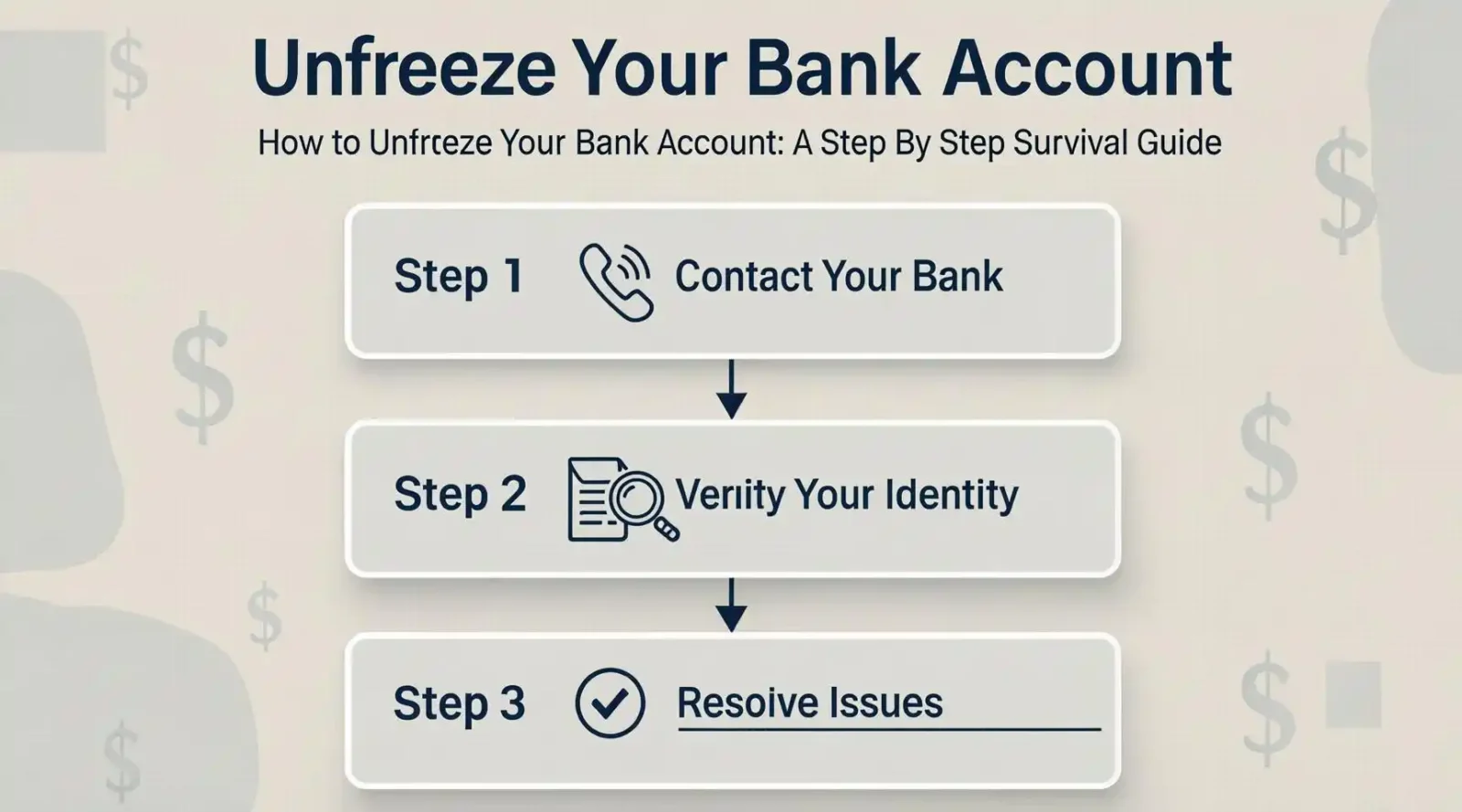
How to Unfreeze Your Bank Account: A Step‑by‑Step Survival Guide
Your ultimate roadmap to getting your money back on track—fast, safe, and stress‑free.
Disclaimer: This article is for informational purposes only and does not constitute legal, financial, or professional advice. Always consult a qualified attorney, certified financial planner, or your bank’s representative for advice tailored to your specific situation.
Table of Contents
- Why Does a Bank Freeze an Account?
- The Immediate Red‑Flag Checklist
- [Step‑by‑Step Guide to Unfreeze Your Account]
- 3.1 Gather Essential Documentation
- 3.2 Contact the Right Department
- 3.3 Verify Your Identity (KYC)
- 3.4 Resolve the Underlying Issue
- 3.5 Submit a Formal Release Request
- 3.6 Follow Up & Confirm Re‑activation
- [Special Scenarios & How to Handle Them]
- 4.1 [Court Orders & Garnishments]
- 4.2 [Suspicious Activity Reports (SARs)]
- 4.3 [Regulatory Holds (e.g., OFAC, FATF)]
- [Know Your Rights: Legal Protections & Consumer Laws]
- [Prevent Future Freezes: Best‑Practice Money Management]
- [Frequently Asked Questions (FAQ)]
- [Final Takeaway]
- Why Does a Bank Freeze an Account?
Understanding the why is the first step toward an effective solution. Banks may place a freeze (also called a hold, block, or restriction) on an account for several legitimate or regulatory reasons:
| Reason | Typical Triggers | What It Means for You |
| Suspicious Activity | Unusual transaction patterns, large cash deposits, or rapid movement of funds. | Immediate access to all funds is halted until the bank can verify legitimacy. |
| Legal Orders | Court judgments, tax levies, child support garnishments, or law‑enforcement subpoenas. | Funds are held to satisfy the legal claim; you’ll receive a notice. |
| Regulatory Holds | Sanctions lists (OFAC), anti‑money‑laundering (AML) flags, or foreign exchange controls. | The bank must comply with government directives; release can take weeks. |
| Account Verification Issues | Incomplete KYC (Know‑Your‑Customer) paperwork, expired ID, or mismatched personal data. | The bank freezes the account until you update your profile. |
| Administrative Errors | System glitches, misapplied holds, or clerical mistakes. | Often resolved quickly once identified. |
| Overdrawn or Defaulted Loans | Failure to meet repayment terms or breach of credit agreements. | Lender may request a freeze to protect collateral. |
Pro tip: Most freezes are temporary and can be lifted within a few business days—provided you act promptly and supply the needed information.
- The Immediate Red‑Flag Checklist
Before you dive into the step‑by‑step process, run through this quick audit. If any item applies, you’re already ahead of the curve.
- Check Your Email & Mail – Banks are required (in many jurisdictions) to notify you in writing about a freeze. Look for subject lines like “Account Hold Notice” or “Important Action Required.”
- Log Into Online Banking – A banner or alert will usually appear on the dashboard.
- Review Recent Transactions – Spot any unfamiliar or large‑value movements that could have triggered a flag.
- Verify Personal Information – Ensure your address, phone number, and ID documents are up‑to‑date.
- Locate Legal Documents – If you’ve been served a court order, garnishment, or tax notice, have it handy.
If you tick any of the boxes above, move straight to Step 1 of the guide.
- Step‑by‑Step Guide to Unfreeze Your Account
Below is the survival guide you can follow today, tomorrow, or whenever you find yourself locked out of your own money.
Step 1 – Gather Essential Documentation
| Document | Why You Need It | Where to Find It |
| Government‑Issued ID (passport, driver’s license) | Verifies identity (KYC) | Wallet / online portal |
| Proof of Address (utility bill, lease) | Confirms residence | Recent mail |
| Bank Statements (last 3‑6 months) | Shows transaction history | Online banking or paper statements |
| Legal Notices (court order, tax levy) | Clarifies the legal basis of the freeze | Mail or attorney |
| Business Registration (if applicable) | For corporate accounts | Secretary of State portal |
| Letter of Authorization (if a third party is acting) | Grants permission to speak on your behalf | Signed by you |
Tip: Create a dedicated folder—digital (PDF) and physical—so you can attach or hand over documents instantly.
Step 2 – Contact the Right Department
Banks have multiple teams: Customer Service, Fraud Prevention, Collections, and Legal. Reaching the correct one saves time.
| Situation | Recommended Contact |
| Suspicious activity hold | Fraud / Security Department |
| Court‑ordered garnishment | Legal / Compliance Department |
| KYC/Verification issue | Account Services / Customer Relations |
| Administrative error | General Customer Service (ask to be escalated) |
How to Reach Them:
- Phone: Use the dedicated line listed on the back of your debit/credit card.
- Secure Messaging: Log in to your online banking portal and use the “Secure Message” feature.
- In‑Person: Visit a branch with your ID and documentation.
When you call, note the representative’s name, badge number, and a reference ticket number. This creates a paper trail for future follow‑ups.
Step 3 – Verify Your Identity (KYC)
Most freezes stem from an identity verification gap. Follow these best practices:
- Answer Security Questions exactly as they appear in the bank’s records.
- Upload Clear Scans of your ID and proof of address (PDF or high‑resolution JPEG).
- Enable Two‑Factor Authentication (2FA) if the bank offers it—this shows you’re proactive about security.
If the bank asks for additional documents (e.g., a recent payslip), provide them within 24‑48 hours to avoid further delays.
Step 4 – Resolve the Underlying Issue
Your account won’t be unfrozen until the root cause is cleared. Below are typical scenarios and the actions you’ll need to take.
- Suspicious Activity
- Explain the Transaction(s): Provide receipts, invoices, or contracts that justify large deposits or transfers.
- Submit a Written Statement: A concise letter (1‑2 pages) describing the nature of the activity, dates, and parties involved.
- Legal Orders
- Obtain a Certified Copy of the court order or levy.
- Pay the Outstanding Amount (if feasible) or negotiate a payment plan with the creditor.
- Provide Proof of Payment to the bank’s legal team.
- Regulatory Holds (e.g., OFAC)
- Consult a Trade‑Compliance Attorney to verify if you’re on any sanctions list.
- Submit a “Letter of Explanation” from your attorney stating why the funds are not prohibited.
- Administrative Errors
- Ask for a Written Confirmation that the freeze was a mistake.
- Request Immediate Re‑activation and ask for a reference number for the correction.
Step 5 – Submit a Formal Release Request
Once you’ve cleared the underlying issue, send a formal unfreeze request. Include:
- Your full name, account number, and contact information.
- A brief recap of the problem and steps taken to resolve it.
- All supporting documents (attach PDFs, not images).
- A clear ask: “Please lift the hold on my account and restore full access to my funds by [date].”
Delivery Methods:
- Secure Email (through the bank’s portal).
- Certified Mail (with return receipt).
- In‑person submission (ask for a stamped receipt).
Step 6 – Follow Up & Confirm Re‑activation
- Set a Reminder for 48‑72 hours after submission.
- Call the same department and reference your ticket number.
- Ask for Confirmation in Writing (email or letter) that the freeze has been lifted.
- Test Your Account: Perform a small transaction (e.g., a $1.00 balance check) to ensure full functionality.
If the bank fails to respond within the promised timeframe, escalate:
- Request to speak with a supervisor or branch manager.
- File a complaint with the banking regulator (e.g., FDIC, OCC, FCA, or your local consumer protection agency).
- Consider legal counsel if the freeze is causing significant financial harm.
- Special Scenarios & How to Handle Them
4.1 Court Orders & Garnishments
- Know the deadline: Some garnishments have a statutory “release” date.
- File a “Claim of Exemption” if you qualify (e.g., low income, essential expenses).
- Maintain a copy of all correspondence with the creditor and the court.
4.2 Suspicious Activity Reports (SARs)
- Banks must file SARs within 30 days of detecting suspicious behavior.
- You have the right to request a copy of the SAR (though banks may redact certain details).
- Cooperate fully with the bank’s investigation to expedite the unfreeze.
4.3 Regulatory Holds (OFAC, FATF, etc.)
- Identify the sanction list the bank is referencing.
- Provide proof that you are not a listed individual or entity (e.g., passport, corporate registration).
- If the hold is erroneous, ask the bank to submit a “reconsideration request” to the regulator.
- Know Your Rights: Legal Protections & Consumer Laws
| Jurisdiction | Key Law | What It Guarantees |
| United States | Electronic Fund Transfer Act (EFTA) | 45‑day limit for error resolution; ability to dispute unauthorized holds. |
| United States | Fair Credit Reporting Act (FCRA) | Right to obtain a free copy of any adverse report that led to a freeze. |
| European Union | General Data Protection Regulation (GDPR) | Right to access, correct, and delete personal data that may trigger a freeze. |
| United Kingdom | Payment Services Regulations (PSRs) | Banks must provide clear reasons for a freeze within 7 days. |
| Canada | Bank Act (Section 459) | Banks must give written notice of a freeze and the specific legal basis. |
Takeaway: If a bank refuses to disclose why your account is frozen, you may have legal recourse under the applicable consumer protection law. Always keep a record of every interaction.
- Prevent Future Freezes: Best‑Practice Money Management
| Action | Why It Helps | How to Implement |
| Maintain Updated KYC Info | Reduces verification‑related holds. | Review your profile quarterly; upload a new ID when it expires. |
| Monitor Transaction Patterns | Detects anomalies before the bank does. | Use budgeting apps (YNAB, Mint) to flag out‑of‑norm spending. |
| Set Up Alerts | Immediate notification of large deposits/withdrawals. | Enable SMS/email alerts for transactions > $500 (or your comfort level). |
| Separate Business & Personal Finances | Prevents cross‑contamination of activity types. | Open a dedicated business account; use accounting software. |
| Keep Legal Documents Organized | Quick response to court orders or garnishments. | Store scanned copies in a cloud folder with two‑factor protection. |
| Know Your Bank’s Policies | Anticipates triggers before they happen. | Review the “Terms & Conditions” and “Privacy Policy” annually. |
- Frequently Asked Questions (FAQ)
Q1: How long does a typical freeze last?
A: Most suspicious‑activity freezes are lifted within 2‑5 business days after you provide the required documents. Legal garnishments can last until the debt is satisfied, which may be weeks or months.
Q2: Can I access a portion of my money while the account is frozen?
A: Some banks allow a limited “emergency withdrawal” (often up to $200) if you can prove an immediate need (e.g., medical expense). Request this explicitly.
Q3: Will a freeze affect my credit score?
A: The freeze itself does not directly impact credit, but missed payments or collections resulting from an inability to pay could. Communicate with creditors promptly.
Q4: Do I have to pay a fee to unfreeze my account?
A: Generally no. Banks may charge a document processing fee for certain legal releases, but a standard verification freeze is free.
Q5: What if the bank refuses to lift the freeze despite my compliance?
A: Escalate to the bank’s ombudsman, file a complaint with the national banking regulator, and consider legal counsel to seek a court order compelling release.
- Final Takeaway
A frozen bank account feels like a financial nightmare, but with a clear, systematic approach you can reclaim access in days—not weeks. Remember these three pillars:
- Identify the cause – Don’t guess; get the official notice.
- Supply proof – Gather documents, verify identity, and address the underlying issue head‑on.
- Follow up relentlessly – Keep a paper trail, set reminders, and escalate when necessary.
By mastering this step‑by‑step survival guide, you’ll not only unfreeze your account but also build a resilient financial habit that protects you from future disruptions.
Ready to Take Action?
- Download the Free Checklist: “Unfreeze Your Bank Account in 7 Days” (link below).
- Subscribe for monthly “Financial Resilience” tips.
- Share this guide on social media—help a friend who might be stuck in the same situation!
Keywords: unfreeze bank account, bank account freeze, financial emergency
Hashtags: #BankingTips #FinancialRecovery #UnfreezeAccount
If you found this guide helpful, please leave a comment or share your own experience. The more we talk about these roadblocks, the easier it becomes for everyone to navigate them.










Leave a comment